
If you have ever felt the quiet ache of going through the motions — waking up to the same routine, chasing the next promotion or family milestone, yet wondering “Is this really it?” — then Héctor García and Francesc Miralles’ gentle masterpiece Ikigai: The Japanese Secret to a Long and Happy Life might feel like a long-overdue conversation with a wise friend.
Published in 2016 and still resonating worldwide in 2026, this slim yet profound book takes readers to the tiny village of Ogimi in Okinawa, Japan — one of the world’s original “Blue Zones” where people routinely live past 100 with remarkable vitality. Through interviews with centenarians and supercentenarians, the authors distill timeless wisdom about purpose, presence, and simple daily habits that nurture both body and spirit.
Ikigai Book Review for Indian Readers navigating the unique pressures of our times — intense career competition, strong family expectations, rapid urbanisation, rising lifestyle diseases, and a growing hunger for meaning beyond material success — this book offers something rare: practical wisdom that feels both foreign and deeply familiar.
Table of Contents
What Exactly Is Ikigai?
In Japanese, ikigai (生き甲斐) combines “iki” (to live) and “gai” (worth or value). It roughly translates to “a reason for being” or, as the authors beautifully put it, “the happiness of always being busy.”
It is not some grand, once-in-a-lifetime revelation. It is the quiet, steady flame that makes you want to get out of bed — whether that is raising a family with love, teaching children, tending a garden, solving problems at work, creating art, or simply being present for the people around you.
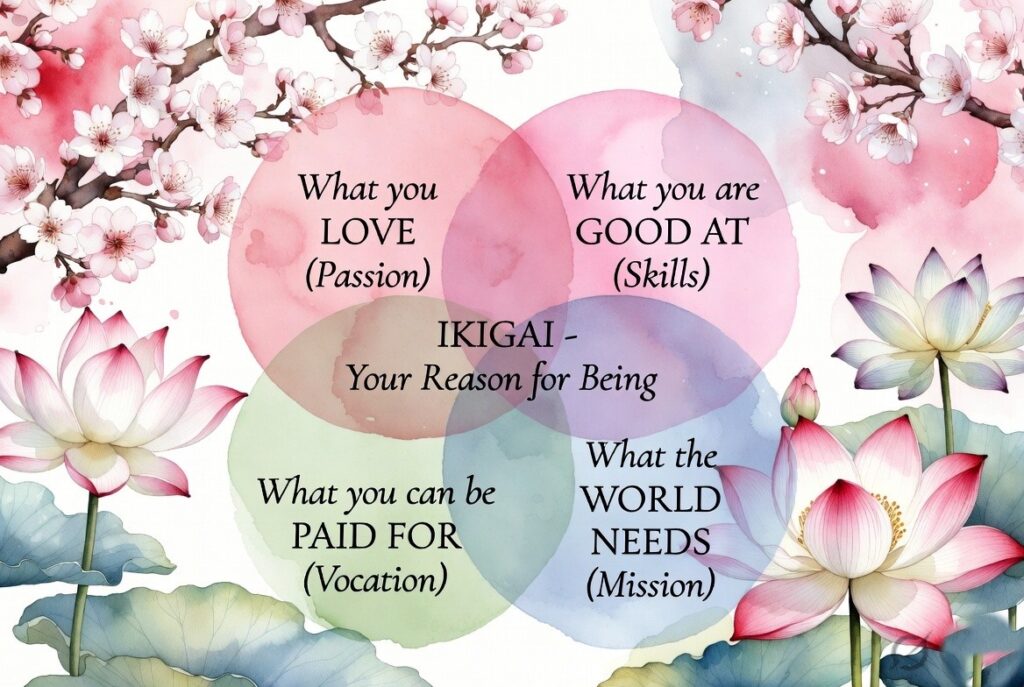
The now-famous Venn diagram (popularised in Western interpretations and featured helpfully in discussions around the book) shows Ikigai at the sweet spot where four circles overlap:
- What you LOVE (your passion)
- What you are GOOD AT (your skills and strengths)
- What the WORLD NEEDS (your mission or contribution)
- What you can be PAID FOR (your vocation or sustainable path)
Many Indian readers will instantly recognise the resonance with our own philosophical traditions. The idea of living according to your swadharma — your unique duty and path based on your nature and talents — echoes powerfully here. The Bhagavad Gita’s teaching of Karma Yoga (selfless action performed with excellence and detachment from results) aligns beautifully with the book’s emphasis on staying active in meaningful work without obsession or burnout.
This is not about quitting your job tomorrow to chase a passion project (though for some it might lead there). It is about infusing whatever you do with deeper purpose and presence.
Lessons from Okinawa’s Centenarians: Wisdom That Feels Close to Home
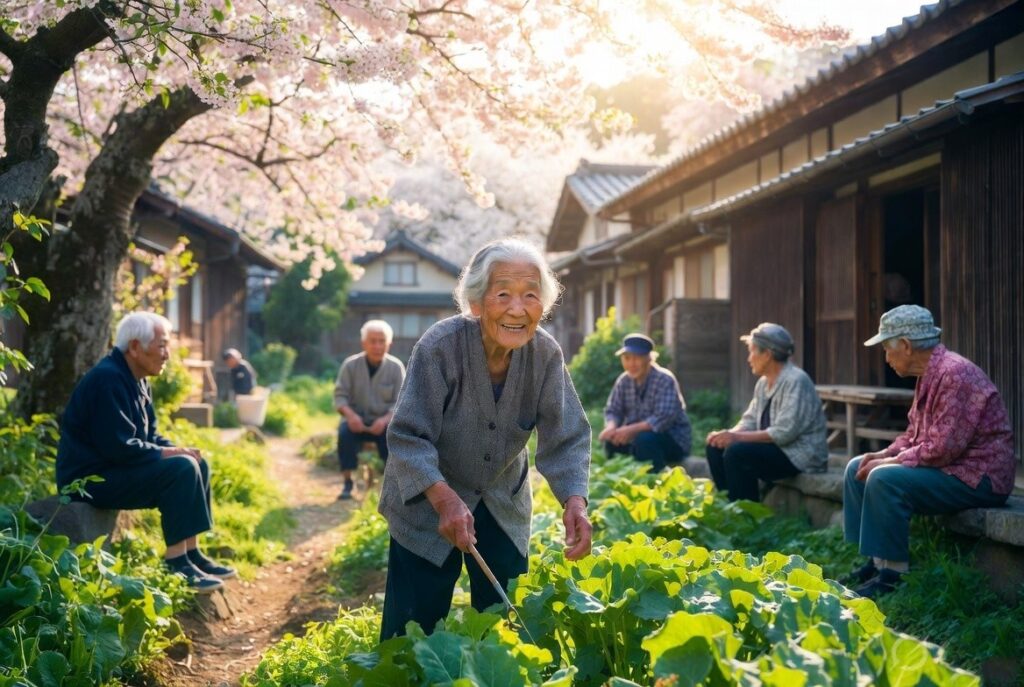
The heart of the book lies in the authors’ visits to Ogimi and their conversations with people who have lived extraordinarily long, joyful lives. These elders do not obsess over “retirement.” They continue doing what they love — gardening, weaving, teaching, caring for family — as long as their health allows. They move gently every day, eat modestly, laugh often, and stay deeply connected to their community.
One of the most touching insights is how these centenarians view purpose. It is rarely one single dramatic thing. It is a collection of small, repeated acts done with care: tending vegetables, sharing stories with neighbours, keeping fingers busy with crafts because “the key to staying sharp is in your fingers.”
For Indian readers, this feels strikingly relatable. Many of our grandparents and elders in villages and small towns still live this way — rising early, working in fields or kitchens, sharing meals and gossip with lifelong friends, finding contentment in simple routines. The tragedy of modern India is how quickly urban migration and “modern success” sometimes strip away these natural sources of ikigai.
The book gently invites us to reclaim them.
The 10 Rules of Ikigai – Deeply Explored for Indian Life
The authors beautifully synthesise the centenarians’ wisdom into ten practical rules. Each one deserves slow reflection, especially when viewed through an Indian lens.
1. Stay active; don’t retire. Purpose does not have an expiry date. In India, we often see two extremes: people working themselves to exhaustion without joy, or others who retire and quickly lose vitality because they have no meaningful activity left. The elders of Ogimi keep contributing — helping family, teaching skills, creating beauty — long after “official” work ends. For us, this might mean continuing to mentor juniors after promotion, starting a small post-retirement consulting practice, teaching classical music or cooking to grandchildren, or joining a local social initiative. The message is clear: when you stop doing what gives you a sense of contribution, a part of you begins to fade.
2. Take it slow. This is perhaps the most radical and necessary advice for today’s India. Our culture of competitive exams, startup hustle, and “always on” corporate life glorifies speed and urgency. The book reminds us that rushing actually reduces quality of life and longevity. “Walk slowly and you’ll go far.” In Indian terms, this aligns with the wisdom of dinacharya (daily routine) in Ayurveda and the mindful pacing encouraged in yoga. Slowing down does not mean becoming lazy — it means bringing full presence to whatever you are doing, whether cooking, working, or talking to your child.
3. Don’t fill your stomach (Hara hachi bu). Eat until you are about 80% full. Okinawans practice this ancient Confucian teaching and enjoy one of the lowest rates of lifestyle diseases. For Indian readers, this is profoundly relevant. We live in a culture of generous hospitality and abundant food — weddings, festivals, family gatherings where overeating is almost a sign of love. Yet diabetes, obesity, and heart disease are rising alarmingly. Practising hara hachi bu alongside Ayurvedic principles of eating according to your prakriti (constitution), choosing fresh home-cooked meals with plenty of vegetables, millets, pulses, and spices like turmeric and ginger, can transform health. Eat slowly, savour every bite, and stop before you feel stuffed. Your body and mind will thank you.
4. Surround yourself with good friends. The Okinawan concept of moai — small, lifelong groups of friends who support each other emotionally and sometimes financially — is powerful. In India, we have strong family bonds, but genuine, deep friendships sometimes suffer in the rush of adult life. Building or reviving a circle of friends who truly know you, with whom you can share worries and dreams without judgment, is pure medicine. Whether it is a weekly adda, a walking group, a book club, or regular family video calls with intention, these relationships become part of your ikigai.
5. Get in shape for your next birthday. Gentle, consistent movement beats intense gym sessions you eventually abandon. The elders move naturally through gardening, walking, and daily tasks. For Indians, this translates beautifully to daily yoga, brisk walking (perhaps while doing pradakshina at a temple or park), household chores done mindfully, or playing with children and grandchildren. The goal is not a six-pack at 60 — it is mobility, energy, and joy so you can keep participating in life fully.
6. Smile. A simple, profound reminder. A cheerful attitude is not about toxic positivity; it is about recognising life’s difficulties while still choosing to appreciate the privilege of being here. In our often high-pressure society, cultivating genuine warmth and humour protects both mental and physical health.
7. Reconnect with nature. Shinrin-yoku (forest bathing) — using all five senses to connect with nature — is gaining popularity worldwide. Many Indians already have this instinctively through village roots, temple gardens, or balcony plants. Even in cities, stepping away from screens to walk among trees, tend plants, or simply sit in sunlight can reset the nervous system. The book’s emphasis on nature as essential nourishment feels especially healing in our increasingly digital lives.
8. Give thanks. Gratitude is universal. The elders give thanks to ancestors, nature, friends, and the simple fact of being alive. Starting or ending the day with a short gratitude practice — for the food on your plate, the people who love you, the body that carries you — builds resilience and happiness. This practice pairs naturally with Indian traditions of daily puja or mindful reflection.
9. Live in the moment. Stop rehearsing the past or catastrophising the future. Today is all you truly have. This teaching echoes the Gita’s call to focus on present action (karmanye vadhikaraste) and the mindfulness cultivated in yoga and meditation. Putting the phone down during meals, truly listening to family members, or immersing fully in one task at a time are simple but revolutionary acts in our distracted age.
10. Follow your ikigai. Your mission, if you have not yet found it, is to discover it. There is a unique contribution only you can make. It may evolve over time. The key is to keep listening to what brings you alive and what the world around you needs.
How to Discover Your Own Ikigai – A Practical Guide for Indian Readers
The book does not hand you a rigid 30-day plan, which is actually one of its strengths. Instead, it encourages patient self-inquiry. Here is a simple, culturally resonant process many Indian readers find helpful:
- Reflect on flow moments. When does time disappear for you? Is it while teaching, cooking traditional recipes, solving technical problems, writing, gardening, playing music, or listening deeply to someone’s story?
- List your natural strengths and skills. What do people often ask you for help with? What comes relatively easily to you?
- Look at the world’s needs around you. What problems in your family, community, city, or country genuinely move you? Education gaps, environmental issues, mental health, elder care, preserving traditional arts?
- Explore sustainable paths. How might you bring your passions and skills into spaces where they can also sustain you — whether through your current job (by reframing its purpose), a side initiative, volunteering that later becomes paid work, or a complete pivot?
- Start small and experiment. Ikigai grows through action, not endless planning. Try one small project this month that combines two or more circles.
Journaling these reflections over weeks or months, perhaps with a cup of chai in the morning, can yield surprising clarity.
Think Like a Monk Book Review 2026: Jay Shetty’s Think Like a Monk Changed My Life

Honest Assessment: Strengths and Limitations
Ikigai is not a perfect or deeply academic book. Some readers (including a few Indian reviewers) find it a bit light on the philosophical depth of the original Japanese concept and more focused on longevity habits and a travelogue-style visit to Okinawa. The popular four-circle diagram is largely a Western framework that the authors reference helpfully but do not centre as the main discovery tool.
However, these “limitations” are also why the book works so well for busy Indian readers. It is short, warm, non-preachy, and immediately actionable. It blends science (Blue Zones research, flow psychology, stress studies), culture, and lived wisdom without overwhelming the reader. For people tired of heavy self-help tomes or purely motivational content, its calm, observational tone is refreshing.
Its greatest gift is the reminder that a long, happy life is built from small, consistent choices made with awareness — choices available to all of us, regardless of income, location, or stage of life.
Who Should Read This Book?
- Professionals feeling burned out or questioning their path
- Parents and homemakers seeking renewed purpose beyond daily responsibilities
- Young adults navigating career choices and societal pressure
- Anyone interested in preventive health, mindful living, or gentle self-improvement
- Readers who loved books like Atomic Habits, The Alchemist, or Robin Sharma’s works and want a calmer, more philosophical companion
Final Reflections: A Book That Invites You to Begin
Ikigai does not promise overnight transformation. It offers something far more valuable: an invitation to slow down, listen inward, and start living with greater intention today.
For Indian readers especially, it arrives at the perfect moment. We are a culture rich in wisdom traditions that already emphasise purpose, balance, moderation, community, and mindful action. This book simply gives us a fresh, accessible language and a set of gentle prompts to reclaim and adapt those traditions for contemporary life.
You do not need to move to a Japanese village or quit everything to live your ikigai. You can begin right where you are — in your kitchen, your office, your neighbourhood, your relationships — by bringing more presence, more contribution, and more joy to the activities that already matter to you.
The elders of Ogimi did not wait for the perfect conditions. They simply kept doing what gave their days meaning, surrounded by people they loved, while moving gently through each moment.
That, perhaps, is the most Indian lesson of all.
If this review has stirred something in you, pick up the book. Read it slowly. Keep a notebook nearby. And begin, even with one small step, to honour the unique reason you are here.
Your ikigai is waiting — not as some distant achievement, but as the quiet, steady pulse of a life well lived.
visit to me at QUORA