
Hey friend, if you’ve ever felt stuck reacting to life instead of shaping it, or if you’ve bought into the endless cycle of productivity hacks that never quite stick, then Stephen R. Covey’s The 7 Habits of Highly Effective People might be the book that finally shifts something deeper for you. First published in 1989, this isn’t a flashy quick-fix manual. It’s a principle-centered framework that has sold tens of millions of copies and continues to influence leaders, parents, students, and anyone tired of surface-level advice.
In this long, honest review we’re going to dig all the way in—without the usual fluff. We’ll walk through each habit with practical examples, look at what still works in 2026, call out the parts that feel dated or overdone, and talk about how real people actually use these ideas today. The goal is simple: help you decide if this book deserves a spot on your shelf (or your reading list) and, more importantly, how to take the useful pieces and make them your own.

Why 7 Habits of Highly Effective People book Still Gets Talked About Decades Later
Table of Contents
Most self-help books fade. This one hasn’t. Covey’s big idea was that lasting effectiveness comes from the inside out. He argued that the “personality ethic” (quick techniques, positive thinking slogans, image management) only works short-term. The real foundation is the “character ethic”—integrity, humility, courage, justice, patience, and other principles that have shown up across cultures and centuries.
That distinction is why the book feels different. Instead of teaching you how to sound confident in meetings, it asks you to become the kind of person whose confidence is genuine. Instead of giving you a new to-do list system, it asks you to decide what actually deserves a place on any list.
The structure is clean and progressive. Habits 1–3 are the “Private Victory”—learning to manage yourself. Habits 4–6 are the “Public Victory”—working effectively with other people. Habit 7 is continuous renewal so the whole system doesn’t burn out. It’s logical. It builds. And when people stick with it, the compounding effect can be significant.

Habit 1: Be Proactive – Taking Responsibility for Your Response
This is the foundation everything else rests on. Covey introduces the idea that between any stimulus and your response sits a space. In that space you have the freedom to choose. Reactive people let that space collapse. They blame the traffic, the boss, the economy, their upbringing, or the weather. Proactive people expand that space. They focus on their Circle of Influence—the things they can actually affect—rather than their Circle of Concern (everything that worries them but sits outside their control).
The language shift is practical. Reactive phrases sound like “There’s nothing I can do,” “That’s just the way I am,” or “He makes me so mad.” Proactive language sounds like “Let’s look at the alternatives,” “I can choose a different approach,” or “I control my own feelings.” It feels small at first, but over weeks it changes how you show up.
In 2026 this habit is more useful than ever. Remote work, constant notifications, and algorithm-driven outrage all push us toward reactivity. Choosing to focus on what you can influence—your skills, your energy, your next conversation, your morning routine—becomes a quiet act of power. Many people start by simply noticing their language for a week. That awareness alone begins to expand the space between stimulus and response.
write review for book 7 habit of highly effective people
Habit 3: Put First Things First – Living by Priorities, Not Urgency
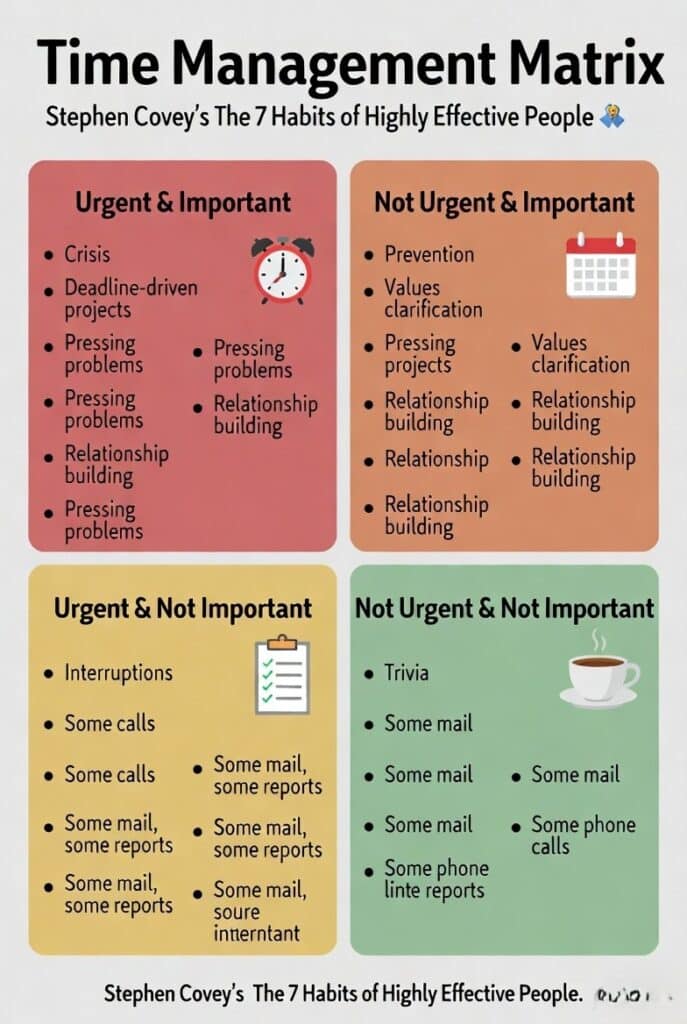
This is where vision meets discipline. Covey’s Time Management Matrix divides activities into four quadrants based on urgency and importance. Most people spend their days in Quadrant I (urgent and important crises) and Quadrant III (urgent but not important interruptions). The effective people deliberately grow Quadrant II—important but not urgent activities such as planning, relationship building, prevention, and skill development.
The weekly planning process Covey recommends is simple but powerful. Identify your key roles, set goals for each role that align with your mission, and schedule the “big rocks” first. Everything else fits around them. Saying no becomes easier because you already know what you’re saying yes to.
In practice this habit fights the modern addiction to busyness. Checking email constantly feels productive but often isn’t. Protecting two hours for deep work or an uninterrupted evening with family usually is. People who stick with weekly planning for a few months commonly report lower stress and higher satisfaction even if their total working hours stay the same.
Habit 4: Think Win-Win – The Abundance Mentality
Once private victory is underway, the book turns outward. Win-Win is not a technique; it’s a character-based approach to relationships and agreements. It rejects the scarcity mindset that says for one person to win, another must lose. Instead it looks for solutions that benefit all parties.
Covey outlines the five dimensions of Win-Win: character (integrity, maturity, abundance mentality), relationships (trust), agreements (clear expectations), systems (reward systems that support Win-Win), and processes (the actual methods used to reach agreements). When any of these is missing, Win-Win becomes difficult or impossible.
In workplaces this habit reduces politics and increases collaboration. In families it turns arguments into problem-solving sessions. The hardest part for many people is developing the courage and consideration to stay in the conversation until a genuine third alternative appears. It takes longer at first. Over time it builds trust that makes everything faster.
write review for book 7 habit of highly effective people

Habit 6: Synergize – Valuing Differences to Create Better Solutions
Synergy is the idea that the whole can be greater than the sum of its parts. When people with different strengths, experiences, and viewpoints truly value those differences and stay open, they often invent solutions neither side could have created alone.
Covey is careful to distinguish synergy from compromise. Compromise is 1 + 1 = 1½. Synergy is 1 + 1 = 3 or more. It requires high trust, good communication skills, and a willingness to stay in the creative tension longer than feels comfortable.
Teams that practice this habit regularly produce more innovative work and higher engagement. Families that practice it handle conflict with less damage and more creativity. The barrier is usually ego—the need to be right or to protect one’s own idea. Habit 5 is the doorway into Habit 6.
Habit 7: Sharpen the Saw – Continuous Renewal
The final habit keeps the other six alive. Covey uses the metaphor of a woodcutter who is too busy sawing to stop and sharpen the blade. Over time the blade dulls and the work becomes harder. Sharpening the saw means regularly renewing yourself in four dimensions: physical (exercise, nutrition, rest), mental (reading, learning, writing), social/emotional (relationships, service), and spiritual (values clarification, meditation, time in nature, or whatever connects you to meaning).
This habit is the antidote to burnout. In 2026, when many people treat rest as optional and learning as something that only happens in formal courses, deliberately scheduling renewal is a competitive advantage. People who protect these four areas consistently find they have more energy, clearer thinking, and greater resilience for the other six habits.
What the Book Does Exceptionally Well
The principles are durable. Proactivity, clarity of purpose, prioritization, mutual benefit, empathic communication, creative cooperation, and balanced self-renewal are not fads. They show up in successful people and healthy organizations across industries and cultures.
The progression from private to public victory is psychologically sound. Trying to improve relationships without first improving yourself usually produces temporary results at best. Covey insists on the order, and experience backs him up.
The book also takes character seriously. In an age of personal branding and curated online personas, the reminder that who you are when no one is watching matters more than your image is still needed.
Honest Criticisms and Limitations
The writing can feel dense and repetitive. Covey loves stories, and some of them stretch longer than necessary. Certain examples feel dated or idealized. Readers looking for quick tactics sometimes leave frustrated because the book insists on deeper internal change first.
Some critics note the religious and philosophical underpinnings (Covey was a devout member of The Church of Jesus Christ of Latter-day Saints). While he works hard to present the principles as universal, the tone occasionally leans moralistic. Others find the Win-Win ideal unrealistic in zero-sum environments or with people who refuse to cooperate.
The book also assumes a level of personal agency and stability that not everyone has equal access to. Structural barriers, mental health challenges, and systemic issues receive less attention than individual choice. That doesn’t make the principles wrong; it simply means they are incomplete as a total philosophy of life.
Who Will Benefit Most—and Who Might Not
If you feel reactive, scattered, or stuck in relationships that drain more than they give, this book can be transformative. Leaders who want to build culture rather than just manage tasks usually find it valuable. Parents who want to model rather than just instruct often appreciate the long-term orientation.
If you already live with strong self-awareness, clear priorities, and healthy communication habits, you may find large sections familiar. If you prefer highly tactical, short-form advice, the philosophical depth might feel slow. And if you are currently in crisis, you may need more immediate support before the deeper work of character development becomes possible.
Making the Habits Work in Real Life in 2026
Start small. Pick one habit and practice it deliberately for 30 days. Many people begin with Habit 1 language awareness or Habit 5 listening in one important relationship. Track what changes.
Combine the principles with modern tools. Use digital calendars for weekly planning (Habit 3) while protecting device-free time for renewal (Habit 7). Practice empathic listening in video calls the same way you would in person. Look for Win-Win solutions in remote collaboration tools.
Revisit the material. This is not a book you read once and shelve. The people who get the most from it treat it as a reference they return to when life feels off-track.
Final Thoughts
The 7 Habits of Highly Effective People is not perfect. It can be wordy, idealistic, and occasionally preachy. Yet its core message remains powerful: effectiveness is not primarily about techniques or talent. It is about character, clarity, and consistent choices aligned with principles that outlast trends.
If you are willing to do the internal work the book asks for, it can change how you spend your time, how you treat people, and how you define success. In a world that constantly pulls attention outward, Covey’s invitation to begin with the end in mind and to live from the inside out still feels radical—and still feels necessary.
Whether you buy the original, an updated edition, or simply absorb the ideas through summaries and practice, the habits themselves are worth testing in your own life. Start where you are. Choose one principle. Practice it until it becomes more natural. Then add the next. Over months and years the compound effect is real.
That’s the quiet promise of this classic—and the reason it continues to earn its place on so many shelves more than three decades later.