
The wait for Rocking Star Yash’s return after KGF: Chapter 2 stretched longer than many expected. When Toxic: A Fairy Tale for Grown-Ups finally arrived in theatres worldwide on 26 August 2026, it carried the weight of enormous expectations, one of the biggest budgets in Indian cinema history, and a title that promised something darker and more grown-up than the usual mass-hero template. Four days later the conversation remains loud, divided, and impossible to ignore.
This Toxic movie review 2026 looks at the film as a complete package: the story it tries to tell, the world it builds, the performances that hold it together, the technical craft that makes it look expensive, and the narrative choices that leave many viewers feeling both impressed and exhausted. The goal is not to declare a winner or loser but to give audiences a clear, detailed picture of what they will encounter in those 194 minutes.
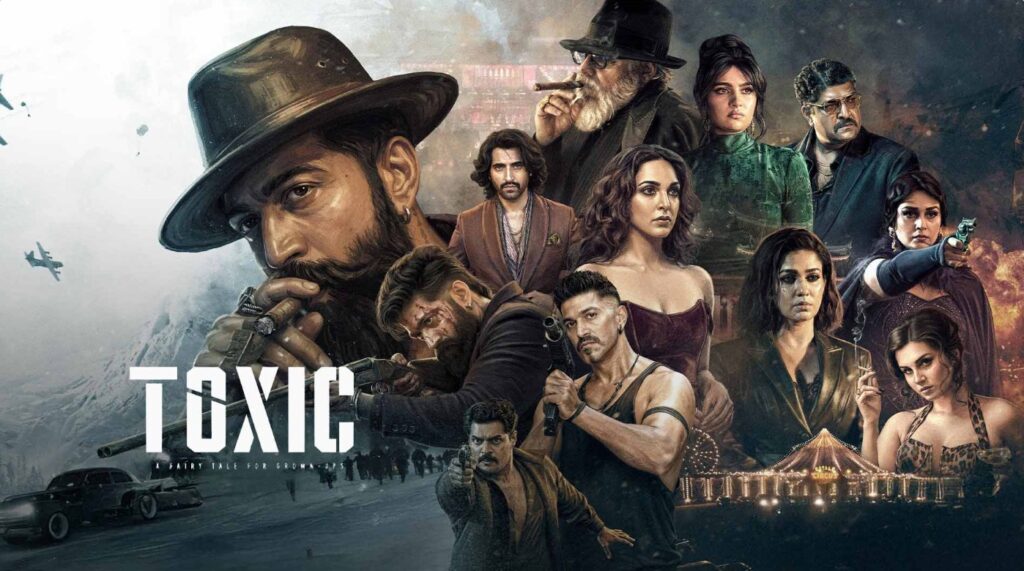
Table of Contents
What Is Toxic About? A Spoiler-Light Plot Overview
Set against the crumbling Portuguese rule in Goa, Toxic follows Raya, a man shaped by childhood violence and raised by his fiercely protective sister Ganga. The siblings operate in the shadowy world of opium and power, first under a local crime boss and then on their own terms. Raya’s rise is marked by calculated alliances, sudden brutality, and complicated relationships with several women who enter his orbit.
A travelling circus becomes a turning point. There Raya encounters Nadia, a performer whose life and fate become tightly bound to his. The story then stretches across decades, moving from the 1940s into later years as power, guilt, abandonment, and the next generation collide. Yash plays both Raya and a younger figure known as Ticket, a dual role that the marketing leaned on heavily and that the film itself treats as central to its psychological layer.
The official synopsis describes a powerful drug cartel operating behind sun-soaked beaches and a violent underworld struggle during the last years of colonial rule. In practice the film is less interested in the mechanics of the trade and more interested in the man at the centre of it: how ambition, love, betrayal, and self-destruction feed one another.
Viewers looking for a straightforward rise-and-fall gangster saga will find pieces of that structure. Those hoping for a tight, emotionally precise character study will find the same pieces stretched across a very long runtime. The film wants to be both a large-scale action epic and an intimate portrait of a damaged psyche. That dual ambition is both its most interesting quality and its biggest source of friction.
The Cast: Who Holds the Screen in This Fairy Tale
Yash carries the film. After four years away from the lead role, he returns with a physically transformed look: heavy beard, imposing frame, and the same magnetic stillness that made Rocky Bhai a phenomenon. As Raya he is often silent, watchful, and then explosively violent. As Ticket the performance shifts toward something more unhinged and theatrical. Critics and audiences have consistently singled out his screen presence as the element that keeps the movie watchable even when the story meanders. The actor co-wrote the screenplay, and that personal investment shows in the commitment to the darker, less heroic beats.
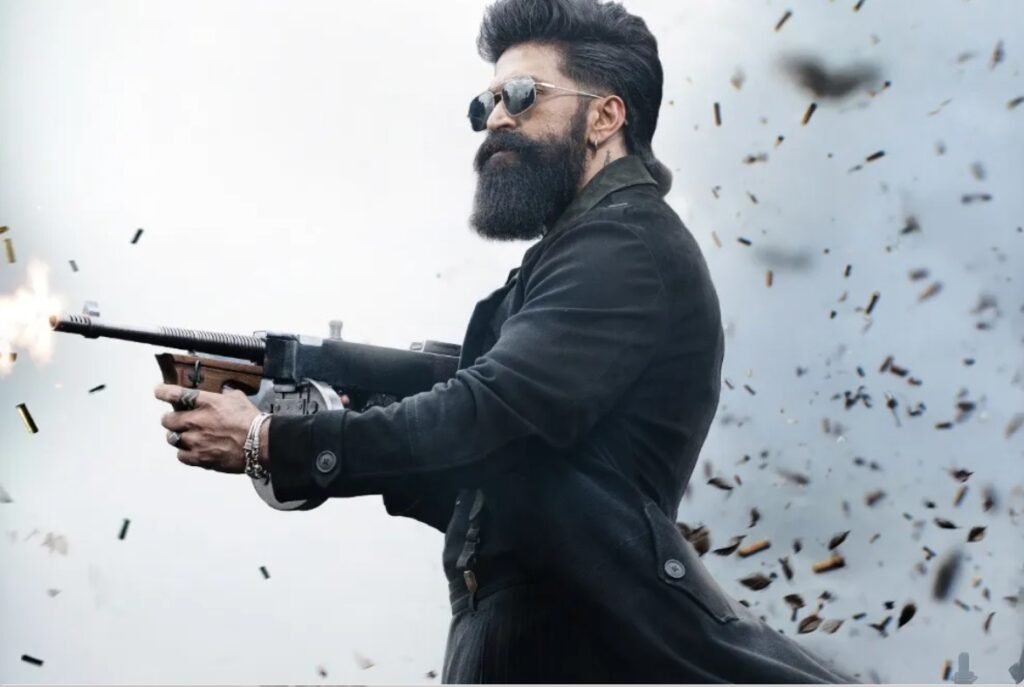
Yash as Raya in an action-ready still from Toxic. The image captures the film’s preferred visual language: rain, fire, weapons, and a star who looks every inch the mythic gangster.
Kiara Advani plays Nadia, the circus performer whose relationship with Raya forms one of the emotional cores of the story. The role asks her to move between vulnerability, sensuality, and eventual despair. Several reviews have called her work one of the more grounded performances in an otherwise heightened film. The circus sequences give her a distinct visual identity that stands apart from the rest of the ensemble.
Nayanthara appears as Ganga, Raya’s sister and the person who has shaped him most. The character is written as both protector and enabler, someone who wants her brother to seize power at any cost. Nayanthara brings her usual intensity to the part, though some viewers have felt the role is underwritten relative to the screen time it occupies.
The supporting cast is stacked with recognisable names. Tara Sutaria plays Rebecca, a woman tied to the rival crime family. Huma Qureshi appears as Elizabeth, another figure in the web of loyalty and revenge. Rukmini Vasanth takes on Melissa, a later relationship in Raya’s life. Akshay Oberoi, Sudev Nair, and Darrell D’Silva fill out the opposing and allied criminal factions. The ensemble is large, and not every character receives the same depth. That is one of the recurring criticisms: the film introduces many people but does not always give them enough room to become more than functions in Raya’s story.
Direction and Screenplay: Two Visions Sharing One Film
Geetu Mohandas comes from a very different cinematic tradition than the mass-hero films that made Yash a pan-Indian star. Her earlier work, including Moothon, showed an interest in mood, character psychology, and unconventional storytelling. Pairing her with Yash, who also co-wrote the script, created an intriguing collision of styles.
The result is a film that often feels like two movies stitched together. One movie is a glossy, large-canvas gangster picture with meticulously designed sets, elaborate action, and the kind of star moments audiences expect from Yash. The other movie is a more interior, almost expressionistic study of a man who cannot escape the damage he has caused and the damage done to him.
When those two impulses align, Toxic produces striking sequences. When they pull in opposite directions, the pacing suffers. The first half has been widely described as stylish but narratively restless, with characters and plot threads introduced quickly and then left to simmer. The second half leans harder into the psychological and dual-role material and has received comparatively more praise from viewers who stayed till the end.
The screenplay’s biggest challenge is length. At 194 minutes the film has time to explore ideas of generational trauma, the cost of power, and the way men in these stories treat the women around them. It also has time to repeat itself, to linger on stylish shots that do not always advance character, and to test the audience’s patience. Several reviews have noted that the film seems more interested in the idea of a complex anti-hero than in the patient work of making that complexity felt scene by scene.

Cinematography, Production Design and the Look of Colonial Goa
If there is one area where Toxic consistently impresses, it is the visual world. Cinematographer Rajeev Ravi, who has collaborated with Mohandas before, gives the film a dark, textured, sometimes painterly look. The recreation of 1940s–1970s Goa, the opium dens, the circus, the later-period interiors, and the outdoor action set pieces all benefit from a production design that clearly had money behind it.
The film was shot simultaneously in Kannada and English across multiple locations including Bengaluru, Mumbai, Goa, Thoothukudi and Jaipur. A large set was built to stand in for period Goa. The result is a movie that looks expensive even in its quieter moments. Rain-soaked streets, fire-lit confrontations, and the colourful chaos of the circus are captured with a level of polish that few Indian gangster films attempt.
That same visual richness can become a problem. Some sequences feel designed first as images and only second as story. Slow-motion, dramatic lighting, and carefully composed frames sometimes slow the narrative rather than serve it. Viewers who respond to atmosphere and craft will find plenty to admire. Viewers who want the story to move with more urgency may find the beauty occasionally ornamental.

Music, Background Score and Sound Design
Ravi Basrur, who scored the KGF films, returns here alongside other composers for the songs. The background score aims for the same larger-than-life quality that defined Yash’s previous hits. In the action sequences it often works, amplifying the scale and the star’s presence. In the quieter or more psychological stretches it can feel overbearing, as if the music is trying to tell the audience what to feel rather than letting the images and performances do the work.
The songs have had a mixed reception. A few tracks found an audience before release, but inside the film they sometimes interrupt rather than enhance the mood. Sound design overall is loud and aggressive, matching the film’s “Adults only” certification and its appetite for violence and intensity. For some that sonic assault is part of the experience. For others it becomes tiring over three hours.

Dhamaal 4 Movie Review 2026: Ajay Devgan Leads a Chaotic Treasure Hunt
Themes: Toxicity, Power, Masculinity and the Fairy Tale That Isn’t
The title is not subtle, and the film does not pretend otherwise. Toxic wants to examine the poison that runs through its central character’s relationships, his family, and the world he builds. Raya is a man who accumulates power while steadily losing the people closest to him. The women in his life are not simply love interests or trophies; they are also victims, enablers, and, in some cases, agents of their own survival.
The film gestures toward a critique of the very masculinity that Yash’s earlier films often celebrated. Whether that critique lands is one of the main points of disagreement among reviewers. Some see a genuine attempt to show the emptiness behind the swagger. Others see the same swagger dressed up in darker clothes and more explicit content, without enough emotional payoff to justify the excess.
The “fairy tale for grown-ups” framing suggests a story that uses familiar genre ingredients to say something less comforting about adult life: how ambition consumes, how love curdles, how the past never stays buried. The ending in particular has been discussed as an attempt to reframe everything that came before. Reactions to that ending range from “the one part that finally coheres” to “an over-explained twist that arrives too late.”
The colonial Goa setting adds another layer. The film places its crime story inside a specific historical moment when power structures were shifting. That backdrop is used more for atmosphere than for detailed political commentary, but it does give the violence a slightly different flavour than a purely contemporary gangster film.

Strengths That Keep People Watching
Even critics who disliked the film have conceded several strengths.
Yash’s performance and star power remain formidable. He can hold a frame, sell a moment of stillness, and then explode into action in a way few current Indian stars match. The dual role gives him more to play with than a single heroic register.
The production values are high. Sets, costumes, cinematography, and action choreography all communicate that this was treated as a major event film.
Kiara Advani’s Nadia stands out for many viewers as a character with her own texture rather than just another figure orbiting the hero.
Individual set pieces, especially some of the later action and the circus-related sequences, deliver the kind of big-screen spectacle that still works in theatres.
The ambition itself is notable. A star of Yash’s stature choosing a female director known for more intimate films, co-writing a story that includes psychological fracture, and accepting an A certificate with heavy violence and adult content is not the safest commercial move. That willingness to take a swing is part of why the film has generated so much discussion.
Weaknesses That Fuel the Mixed Reviews
The most common complaint is pacing and length. Three hours and fourteen minutes is a lot of movie when the emotional through-line is not always clear. Scenes that should tighten the story sometimes feel like they exist to showcase production design or the lead actor’s presence.
Character writing for the women has drawn particular criticism. Despite an impressive female cast, several reviews argue that the film does not give those characters enough independent interior life. They exist primarily in relation to Raya.
The screenplay has been called inconsistent. Plot threads appear and disappear. Tonal shifts between mass-hero action, romantic intensity, and psychological horror can feel abrupt rather than purposeful.
Editing choices, including the use of slow motion and rapid cutting in some action scenes, have been described as making the film feel like a very long trailer rather than a complete narrative.
The background score and certain songs have been cited as overbearing. When every moment is scored at maximum intensity, quieter scenes lose their impact.
Comparisons to KGF are inevitable and often unflattering. Viewers who wanted a complete break from that template have found too many echoes. Viewers who wanted a bigger, darker KGF have found the story too diffuse.
Box Office, Certification and the Conversation After Release
Toxic opened to strong numbers, driven by Yash’s fan base and the long gap since his last film. It collected over ₹100 crore net in India on day one and has continued to play, though word of mouth has been mixed rather than uniformly positive. The worldwide gross in the first few days crossed ₹200 crore, respectable for a film of this scale but not the runaway phenomenon some had predicted.
The Central Board of Film Certification gave the film an A rating. The runtime, violence, sexual content, and substance use all contributed to that decision. This is Yash’s first A-certified film as a lead, another sign that the project was intended to feel different from his previous work.
Social media reaction has been characteristically split. Fans have celebrated the star’s look, the action, and the sheer scale. Detractors have used words like “style over substance,” “overlong,” and “confused.” Professional reviews have clustered in the mixed-to-negative range, with praise usually reserved for craft and performance rather than the script as a whole.
Who Should Watch Toxic in Theatres?
Toxic is not a casual Friday-night watch. It is long, loud, violent, and adult in both content and certification. It will likely work best for:
- Dedicated Yash fans who want to see him in a darker, more physically imposing avatar and who are willing to sit through a three-hour film for the high points.
- Viewers who enjoy large-scale Indian period crime films and can tolerate uneven storytelling if the images and set pieces are strong.
- Audiences interested in the collision between a mass star and an arthouse-leaning director, even if that collision is messy.
It will be a harder sell for:
- People who prefer tightly written, emotionally precise dramas.
- Viewers sensitive to graphic violence, sexual content, or prolonged scenes of psychological distress.
- Anyone hoping for a straightforward, crowd-pleasing hero’s journey in the KGF mould.
The film is currently playing in multiple formats including IMAX and 4DX in some markets. The scale of the production is one argument for seeing it on a large screen rather than waiting for streaming, provided the viewer is prepared for the runtime.
Final Verdict in This Toxic Movie Review 2026
Toxic: A Fairy Tale for Grown-Ups is an ambitious, expensive, visually striking film that never quite becomes the coherent whole it wants to be. Yash gives a committed, physically commanding performance. The world of colonial and post-colonial Goa is rendered with impressive craft. Individual sequences linger. The attempt to examine toxicity, power, and a fractured mind is more interesting than most star vehicles.
At the same time the film is overlong, tonally unsteady, and narratively under-disciplined. It asks for three hours of attention and does not always repay that attention with clarity or emotional depth. The result is a movie that many will remember for how it looked and how Yash occupied the frame rather than for a story that fully landed.
It is neither the disaster some early reactions claimed nor the daring masterpiece the marketing sometimes implied. It is a big, flawed, occasionally gripping experiment from a star who could have chosen the safer path and did not. That fact alone makes Toxic worth discussing. Whether it is worth three hours of a viewer’s time depends on how much they value spectacle, star power, and ambition over narrative tightness.
For those still deciding, the safest recommendation is this: go in knowing it is a long, adult, visually rich gangster film with a psychological twist, not a lean crowd-pleaser. Lower the expectation of perfection and the experience becomes easier to meet on its own terms.
The conversation around Toxic is likely to continue as more audiences see it and as the film finds its place in Yash’s filmography. For now it stands as a fascinating, imperfect, and very expensive fairy tale that grew up in public.
follow me on SPOTIFY As Discovering With Dev