Bollywood in 2026 has been a year of giants. Big stars. Bigger budgets. Even bigger opening-day noise. And then there is Hanuman Ansh — a 150-minute Hindi biographical drama that arrived on 7 August with almost no publicity, a reported budget of around ₹2 crore, and an opening day of roughly ₹10 lakh. Six weeks later, the same film is still filling halls, expanding into Telugu markets, travelling overseas with Hombale Films, and sitting comfortably past the ₹250 crore India-gross mark.
That is not a normal box-office story. It is closer to folklore.
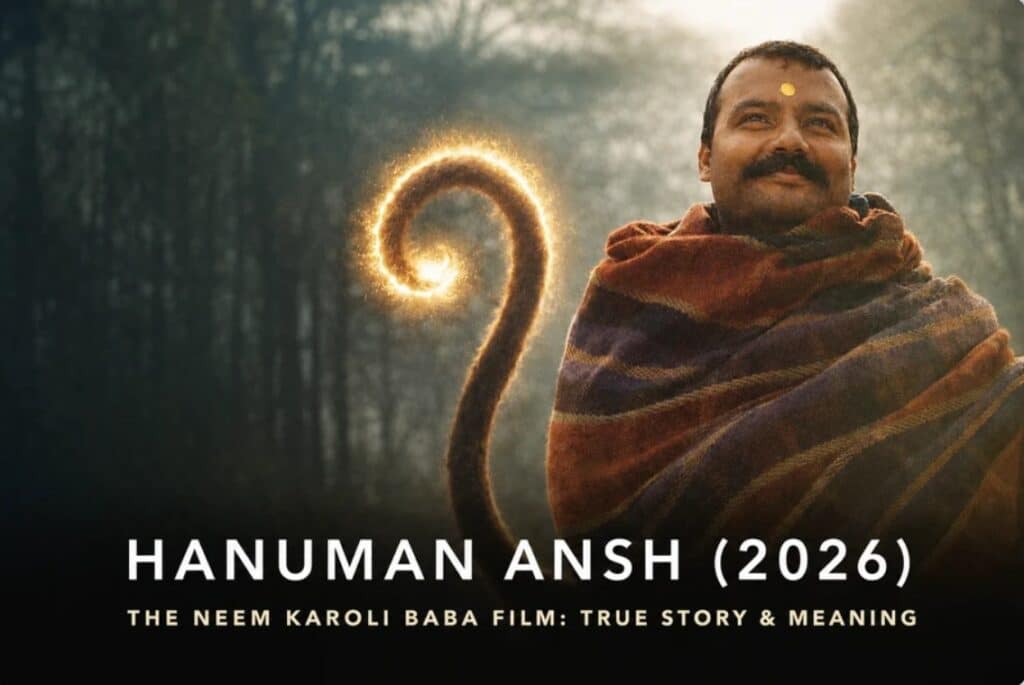
Hanuman Ansh is not a VFX spectacle about Lord Hanuman leaping across oceans. It is a quiet, stubbornly old-fashioned film about a grieving boy from Braj who goes looking for God so he can meet his mother again — and, along the way, becomes the saint the world would later know as Neem Karoli Baba, or Maharaj-ji. The title itself is the film’s thesis: some lives are not just devoted to Hanuman. They feel like a fragment of him.
This Hanuman Ansh movie review looks at the story, the performances, the filmmaking, the spiritual history behind it, why audiences refused to let it die after a disastrous first fortnight, and whether the film actually earns the devotion it has inspired.
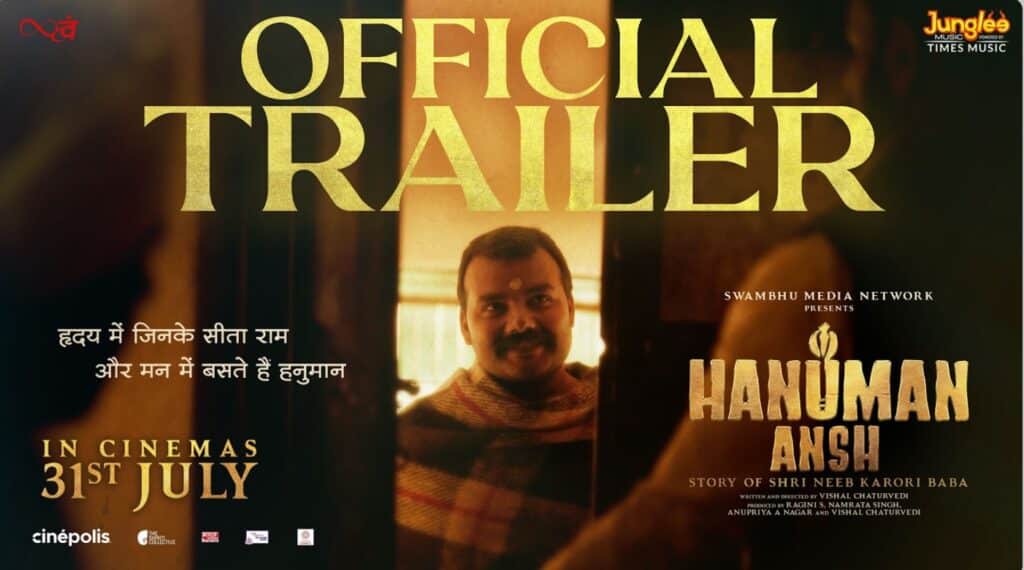
Table of Contents
What Is Hanuman Ansh movie About?
Written, directed and produced by Vishal Chaturvedi under Swambhu Media Network (with co-producers Ragini Sona, Namrata G. Singh and Anupriya A. Nagar), Hanuman Ansh is the first chapter of a planned trilogy drawn from Chaturvedi’s book Divine Detour: That Changed My Life.
The official logline is simple and almost childlike: a grieving boy seeks God to meet his departed mother, and in finding the divine, learns to serve humanity with miracles of love, food and silent blessings, becoming Hanuman Ansh — Neem Karoli Baba.
That sentence is the whole film. Everything else — the train that will not move, the underwater meditation, the reluctant marriage, the walk toward Kainchi — is an unfolding of that one wound.
The story is set in pre-Independence and early twentieth-century North India. Thirteen-year-old Lakshminarayan Sharma (often called Lakshmi at home) loses the person he loves most. Adults tell him his mother has gone to Ram. For a child, that is not philosophy. That is an address. If Ma is with Ram, then the only reliable guide to Ram is Hanuman. So the boy leaves Akbarpur in the Braj region and begins walking.
He is not looking for fame. He is looking for a reunion.
Plot Walkthrough (Spoiler-Light, Then Deeper)
The first hour belongs almost entirely to the child. Vihaan Shedge plays young Lakshmi / Maharaj-ji in his early teens, and the film is wise enough to stay with his confusion instead of rushing toward sainthood. Temples do not automatically soothe him. Mahants test him. Comfort feels like a trap. Even praise feels like a leash. At a Vaishnava temple in Rajkot, an old mahant recognises something unusual in the boy and tries to hold him. Lakshminarayan leaves anyway. Institutions, the film suggests, can become another form of bondage.
Years of wandering follow. Forests. Riverbanks. Alms. Naga sadhus. Nath traditions. Nature becomes the actual classroom. One sequence that audiences keep talking about has the young seeker remaining underwater so long that villagers assume he has drowned — until he surfaces as if time itself had paused for his tapasya.
By his mid-twenties, Lakshman Das (the name he grows into) boards a first-class coach without a ticket, heading, of all places, toward Britain. A colonial official has him thrown off. The train then refuses to move. No mechanical fault is found. The station master eventually concludes that the removal of this particular passenger is the problem. Tickets appear. An apology is extracted. The only condition the saint sets is that no sadhu in India should ever again be deboarded for want of a ticket. He taps the ground and says a station will rise there. That place becomes Neem Karori Station in present-day Farrukhabad district — and Lakshman Das becomes Neem Karoli Baba.
Family finds him. A childhood marriage to Rambeti is invoked. He returns, ensures her welfare, and leaves again after a land dispute around a temple. The closing movement points toward the Kumaon hills and Kainchi, where the larger public legend of Maharaj-ji will later take root. The film ends not with a full-stop but with a doorway — a clear invitation to the second part.
Chaturvedi uses a framing device that keeps the biography from turning into a museum tour: a grandfather recounting these incidents to a grandchild. The child’s questions become the cuts. It is an old Indian storytelling habit, and it suits a film that is less interested in “and then this miracle happened” than in how a boy’s grief slowly turns into seva.
Who Was Neem Karoli Baba — And Why Does the Title Say Hanuman?
This is the question that has followed the film since release: is Hanuman Ansh about Lord Hanuman or about Neem Karoli Baba? The honest answer, and the film’s actual twist, is both.
Neem Karoli Baba (also spelled Neeb Karori Baba), known to devotees as Maharaj-ji, is widely revered as a Hanuman bhakta of unusual intensity — and, in the living tradition around him, as a presence through whom Hanuman’s compassion became available in human form. He is associated with ashrams at Kainchi Dham near Nainital, Vrindavan and other sites. His public teaching was almost aggressively simple: love everyone, feed people, remember God, do not make a project out of your own holiness.
His reach later spilled far beyond Uttar Pradesh and Uttarakhand. Western seekers in the 1960s and 70s carried his name into American counterculture and Silicon Valley lore. Ram Dass wrote about him. Steve Jobs visited Kainchi Dham. Mark Zuckerberg and Julia Roberts have spoken of the same pull. The film does not turn that celebrity roll-call into a climax — a restraint that actually helps it — but the afterlife of Maharaj-ji is part of why a “small Hindi saint film” found an audience that marketing departments cannot manufacture.
The title Hanuman Ansh (“fragment / portion / descendant of Hanuman”) is therefore not a gimmick. It is the theology the story is testing. If Hanuman is the ideal of selfless service to Ram, then a human life that keeps choosing service over identity starts to look like a living echo of that ideal. The film keeps returning to that idea without sermonising it into a PowerPoint.
Cast and Performances
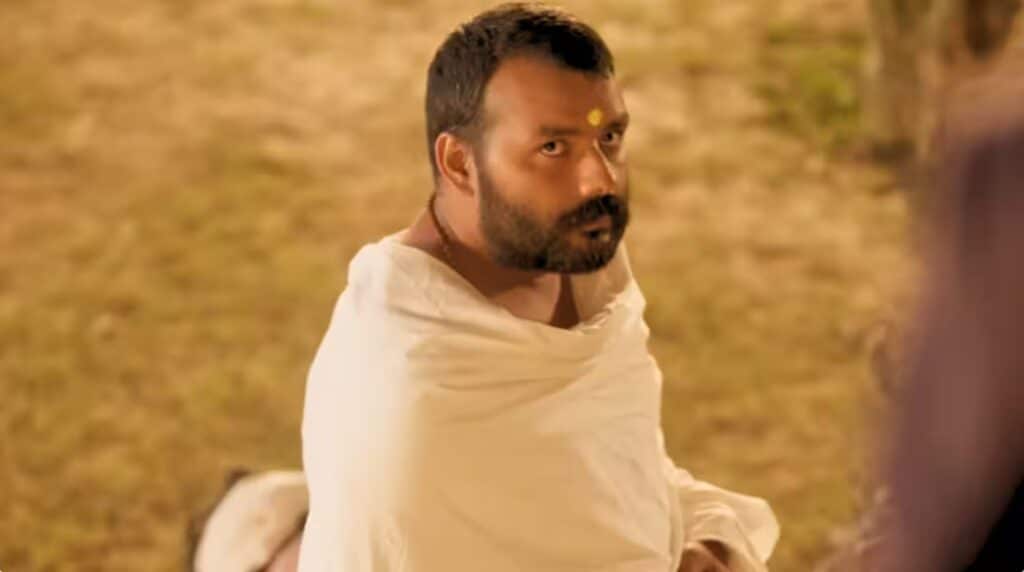
Shobhinaw Satyaa as Lakshminarayan / Neem Karoli Baba
The most interesting production story in Hanuman Ansh is not a visual effect. It is the lead actor. Shobhinaw Satyaa (also spelled Shobhinav Satyaa) was working on the film as a second assistant director when the originally cast lead fell ill. He auditioned. He stayed.
That accident shows on screen in the best possible way. Satyaa does not play Maharaj-ji as a glowing calendar saint. The tilak is there. The blanket is there. The smile is there. But the performance is built on stillness more than speeches. He listens more than he declares. When the film needs warmth, he offers it without performing warmth. When the film needs a flicker of irritation at worldly pettiness, he lets it pass across the face and disappear. For a first-time (or near-first-time) lead carrying a figure millions already hold as sacred, that is a high-wire act. He does not slip often.
The risk in any guru biopic is impersonation. Satyaa mostly avoids it. He plays a man being emptied of ordinary ambition, not an actor reciting miracles.
Vihaan Shedge as Young Lakshmi
If the adult performance holds the film’s dignity, the child performance holds its heart. Vihaan Shedge, a young Marathi actor, plays the thirteen-year-old who cannot accept that death is an ending. The curls, the silence, the way he sits in trees or by water as if the body were optional — these images are what viewers carry out of the theatre. A saint film lives or dies on whether the audience believes the child. Here, they do.
Supporting Cast
Chandan K. Anand plays Ram Nandan Bhosale with the slightly sceptical, grounded energy the story needs so it does not float away. Anil Rastogi’s Mahant-ji is one of the better portraits of institutional religion in recent Hindi cinema: not a villain, just a man who has organised the sacred until it started organising him. Purnima Tiwari as Rambeti / Ram Beti has limited screen time but carries the film’s most uncomfortable historical note — a child marriage the film acknowledges rather than airbrushes. Bhagvandas Patel, Neha Paranjpe, Gulshan Pandey, Nikhil Dubey, Rajiv Mishra and Aleksei Danilov (as the colonial official Mr. Francis) fill out a world that feels populated rather than dressed.
Nobody “steals” the movie, which is correct. A film about egolessness cannot afford a scene-stealer.
Direction: Faith Without the Firework Factory
Vishal Chaturvedi has been carrying this story for years. Research that began informally around 2009 became systematic later, with visits to Vrindavan, Akbarpur, Neeb Karori, Lucknow and other sites associated with Maharaj-ji. He has said the team privileged incidents that appear in books or documented accounts, using cinematic glue only to connect them. He has also said there is no conventional villain — the real antagonist is habit, restlessness, the need to possess.
That philosophy is visible. Hanuman Ansh refuses the commercial template that turns every Indian spiritual story into either a mythological action film or a tear-soaked hagiography with a climax song. There are miracles, yes. The train sequence is the most famous. But the camera is more interested in the person standing beside the miracle than in the special effect.
The limitation of that approach is also obvious. The craft is uneven. Some transitions are abrupt. A few supporting performances stay at “functional.” The production design does a lot with very little, which sometimes means the frame looks sincere rather than beautiful. Critics who gave the film around 3.5/5 said almost the same thing: the journey of Baba moves you; the filmmaking is honest more than accomplished.
In 2026, that honesty has turned out to be an advantage. Audiences tired of ₹300-crore noise have treated the roughness as proof of faith rather than as a defect.
The film was shot astonishingly fast — the script in about a month, principal photography in roughly 22 days, much of it in Chitrakoot and Mumbai, with an opening stretch around a Hanuman shrine and a cave associated with Baba’s sadhana. A first-look poster was launched at Kainchi Dham. That geography matters. This is not a studio’s idea of the Himalayas. It is a filmmaker walking the same dust.
Music, Sound and the Devotional Texture
The soundtrack is credited principally to Sadhu Sushil Tiwari, with contributions from Dhirendra Mulkalwar, Rishi Pathak, Shreyas Dharmadhikari, Sunil Lodhi and others. Tracks such as “Aavagaman,” “Maine Tere Hi Bharose,” “Jai Hanuman,” “Bajrang Baanka,” “Vaishnav Jan To,” and even Krishna Das’s “Om Namah Shivaya” and “Shri Ram Jai Ram” sit inside the film like living practice rather than as chart bait.
That is both the strength and the ceiling. The songs are meaningful. They are not, by mainstream 2026 standards, “hooks.” Early trade reviews called the music ordinary and the background score more effective than the album. Fair enough. What the music does achieve is atmosphere. Bhajans here are not interval entertainment. They are how the boy stays alive.
Sound design by Shishir Chousalkar and Mayur Mohanan does quiet work — river, rail, temple bells, the particular hush of a hill ashram — that sells the film’s low-budget world more convincingly than any glossy grade could.
Cinematography and Craft on a ₹2 Crore Budget
Vishal Bawa’s camera does not have the luxury of cranes and second units. It leans on faces, trees, water, and the ochre-white palette of North Indian sacred life. Some frames, especially of the child against forest light or of Satyaa wrapped in a checked blanket, have the unforced quality of a photograph taken by a devotee rather than a hired unit.
Editing by Shankh Rajadhyaksha (with Ritish Kesharwani) is sharper than the rest of the package. At 150 minutes the film is long for its budget, but it rarely feels padded in the way big studio devotionals often do. When it drags, it is because spiritual time is allowed to stay spiritual time. Some viewers will call that slowness. Others will call it the point.
The U certificate and the decision to play the film with Braj and Bundeli subtitle support in parts of North India tell you who the makers thought their first audience was: families, pilgrims, small-town halls, people who still treat a cinema visit as a kind of darshan.
The Box-Office Miracle Nobody Budgeted For
If the film were only sincere, this review would end as a respectful footnote. The reason Hanuman Ansh is a national conversation is the money — or rather, the impossibility of the money.
Reported production budget: about ₹2 crore (some accounts say ₹1.5–1.8 crore).
Day 1 India net: about ₹10 lakh.
Week 1: about ₹1.08 crore.
Week 2: about ₹40 lakh, with shows collapsing from a few hundred screens toward a few dozen. The film looked finished.
Then word of mouth — the oldest, least fashionable distribution engine in Indian cinema — took over.
Week 3 jumped to roughly ₹10.40 crore. Week 4 added around ₹61 crore. Week 5 kept printing double-digit daily numbers. By Day 24 the film had already made more on a single Sunday (about ₹12.75 crore net) than it had in its entire first three weeks combined. By Day 31 it notched an estimated ₹22.75 crore net in one day. By Day 38, still in its sixth week, it collected about ₹22.50 crore net on a Sunday and beat the combined Sunday haul of much newer, much louder releases. India gross by mid-September sat in the ₹250-crore zone; worldwide numbers climbed further once Hombale Overseas opened the film internationally on 11 September 2026, a date chosen with care — it marked the 53rd mahasamadhi anniversary of Neem Karoli Baba.
Trade trackers have described it as the cheapest Indian film to enter the ₹200-crore club and one of the highest-ROI titles in the industry’s history, often placing it in the same conversation as Jai Santoshi Maa (1975) — another modest devotional that audiences simply refused to abandon.
Hombale Films, the banner behind KGF and Kantara, picking up overseas rights was the moment the industry stopped treating this as a fluke. Trivikram Srinivas presenting the Telugu version for an 18 September 2026 release in Andhra Pradesh and Telangana is the next chapter of the same surprise. A film that North Indian trade circles once assumed had no “all-India legs” is now being introduced to two of the most demanding film markets in the country by one of Telugu cinema’s most respected names.
Uttarakhand making the film tax-free after the Chief Minister watched it in Dehradun only added official punctuation to what audiences had already decided.
IMDb users, meanwhile, have parked the film near 8.9/10 from thousands of ratings — the kind of number that usually belongs to either a consensus classic or a highly motivated fan base. In this case it is a bit of both.
The lesson is brutal and useful. Opening-day occupancy is not the same thing as cultural demand. A story that people want to take their parents to will outlast a story that people want to tweet about.

What Works
The emotional engine is clean. A child looking for his mother is older than cinema. The film does not complicate that motive with politics or plot machinery.
The Hanuman–Baba braid is intelligent. Instead of choosing between mythology and biography, Hanuman Ansh treats them as two languages for the same hunger.
Performances from Satyaa and Shedge carry more weight than the budget should allow.
The film respects seva. Food, silence, the refusal to humiliate a ticket-checker or a colonial officer — these are the “action scenes.” In a year of revenge sagas, that choice feels radical.
It trusts word of mouth. There is something almost theological about a saint film that had to earn its screens the hard way.
Hanuman Ansh in the Lineage of Indian Devotional Cinema
Indian popular cinema has always had a double life — one life for the city, another for the sacred. Jai Santoshi Maa in 1975, Jai Santoshi Maa’s many remakes, the Jai Santoshi Maa / Jai Maa Vaishno Devi circuit, more recently the unexpected afterlife of films that treat faith as lived practice rather than as CGI theology — Hanuman Ansh belongs in that family, not in the family of Adipurush-style spectacle.
What is new in 2026 is the infrastructure around it. A ₹2 crore film can now ride Instagram reels of people crying in the last row, WhatsApp forwards from pilgrimage towns, and a second release window in Telugu with a major presenter attached. The old sant-film audience never disappeared. The industry simply stopped budgeting for it.
There is also a quieter cultural argument inside the film. In an era when “spirituality” is often packaged as wellness, Hanuman Ansh keeps dragging the idea back to hunger, tickets, widows, temple land and the obligation to feed whoever is standing in front of you. Maharaj-ji’s most repeated instruction was not a metaphysical puzzle. It was lunch.
The Real Kainchi Dham and Why Geography Matters
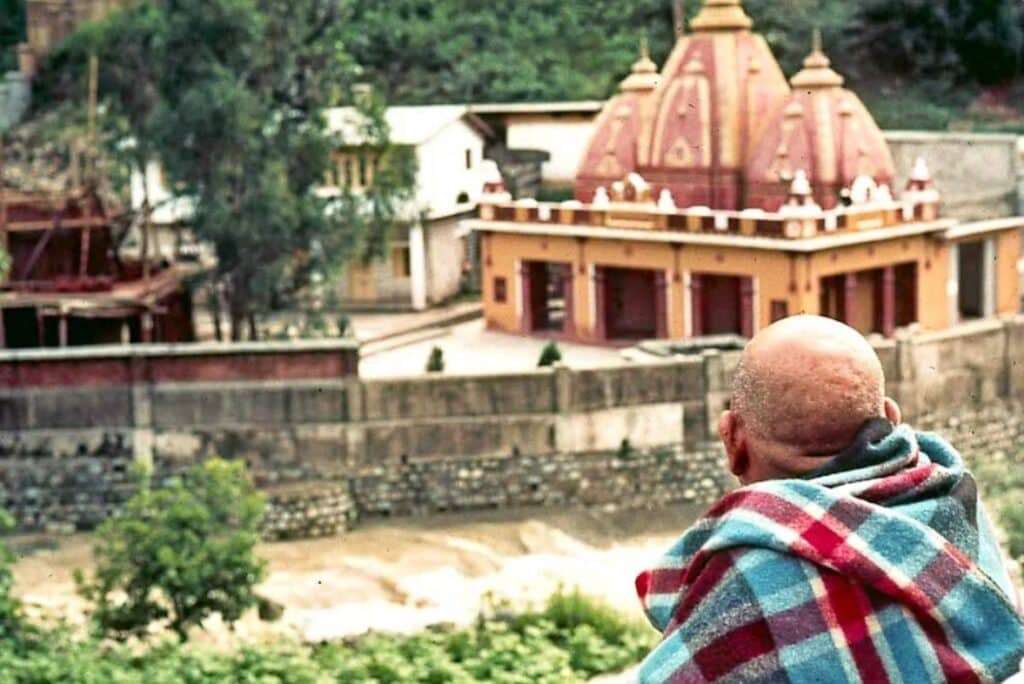
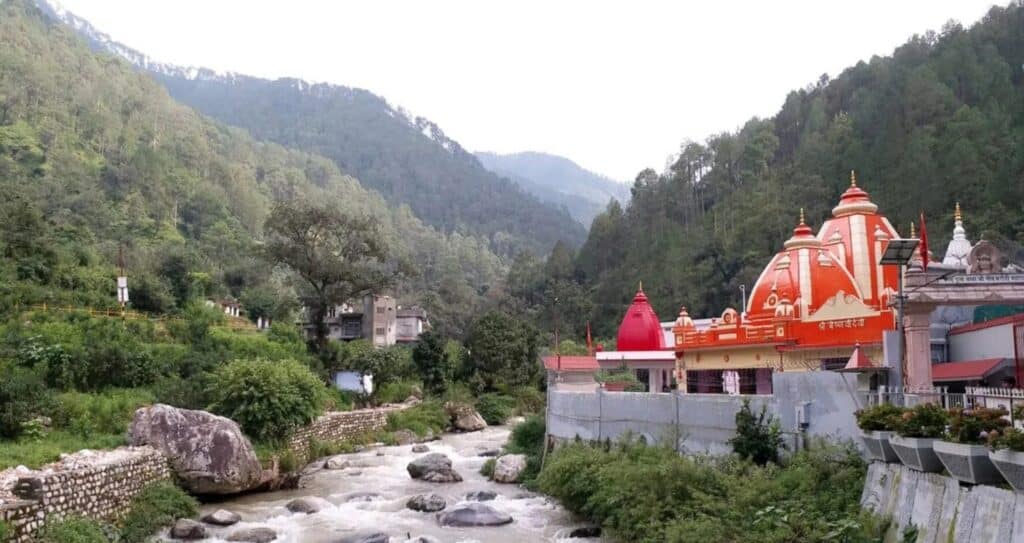
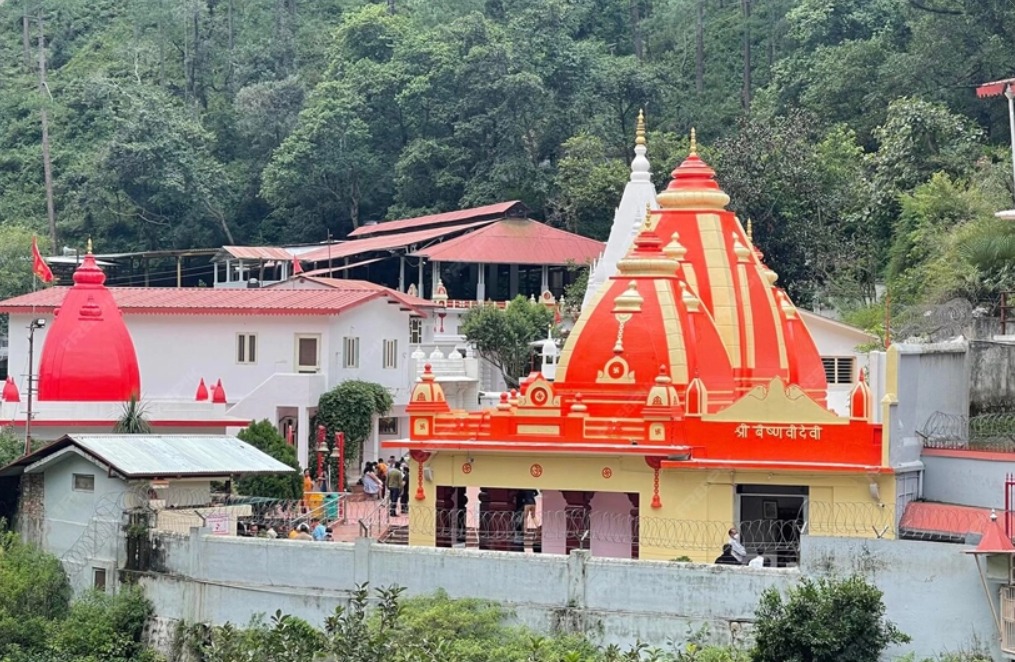
Kainchi Dham, in the Bhowali range of Nainital district, is not a set. It is a working ashram-temple complex on a mountain stream, painted in the familiar red-and-cream of North Indian sacred architecture, surrounded by deodar and oak. Devotees still queue there. The film only arrives at the threshold of this later life — the first instalment is the making of the man, not the full ashram years — but the closing gesture toward those hills is the reason a sequel was always part of the plan.
Producers have said Part Two will sit more deeply with Kainchi, Agra and Mathura, while a third film may open the story onto Maharaj-ji’s international afterlife. Chaturvedi has confirmed that work on the next chapter has begun. Shobhinaw Satyaa is expected to return.
If Part One is the wound and the wandering, Part Two will have to be the ashram — the harder film, because community is less cinematic than solitude.
Comparisons With 2026’s Other Hindi Releases
It is impossible to talk about Hanuman Ansh in September 2026 without mentioning the crowded lane it was born into. It opened in the same late-monsoon corridor that also saw other Hindi titles fighting for screens. Trade notes even record its first week overlapping with films that arrived with far more noise. The difference is the curve. Those films peaked early. This one inverted the graph.
Later, during its fifth and sixth weeks, daily collections of Hanuman Ansh were still competing with — and sometimes beating — newer, starrier titles. That is not a verdict on those other films. It is a verdict on appetite. There is a large Indian audience that will still choose a saint’s walking tour over a gangster’s interval twist, provided the saint feels true.
The profitability conversation is even sharper. A film that returns a hundred times its budget does not just enrich its producers. It rearranges what financiers think is possible. Anupriya Nagar, who came into the project as a young co-producer after encountering Maharaj-ji through Western writing on Steve Jobs, has said the investment was never meant as a financial bet. The market then made it one anyway.
Who Should Watch Hanuman Ansh?
Families looking for a U-certificate film that children can sit through — with patience.
Devotees of Hanuman or of Maharaj-ji who want a screen story that does not turn either figure into a superhero cartoon.
Viewers who liked the sincerity of older sant films more than the polish of new mythologicals.
Anyone curious about how a movie becomes a pilgrimage.
Who may bounce off it: viewers who need pace, irony, or technical dazzle; viewers allergic to overt faith; viewers who want a comprehensive cradle-to-mahasamadhi biopic in one sitting. This is only the first third of a life.
Runtime is 150 minutes. Language is Hindi. Certificate is U. Overseas release began 11 September 2026. Telugu version follows on 18 September 2026.
A Note on Belief, History and Cinema
Any review of a living saint’s early life has to hold two thoughts at once. One: oral miracle traditions are not the same thing as archival history, and a film that stages a train that will not move is making a faith claim, not filing a railway report. Two: reducing Maharaj-ji to “just a good man with good PR” is its own kind of arrogance. The people filling halls in week six are not confused about the difference. They are choosing the story they want to sit inside.
Hanuman Ansh is at its best when it stays with the human scale — a boy who cannot accept absence, a young man who will not keep a ticket if keeping it means becoming smaller, a saint who would rather feed you than impress you. It is at its weakest when it tries to prove the divine with the tools of a modest effects budget.
That tension is also why the film works as cinema in 2026. It does not resolve the argument. It just keeps walking.
Sequel, Oscars Talk, and What Comes Next
The first film was always designed as a trilogy. The ending is engineered that way. Producers have sketched a map: Part One from early life through the road to Kainchi; Part Two centred more fully on Kainchi and the Mathura–Agra years; Part Three possibly international. Scripts for the later films were not locked when Part One exploded, which is both a risk and a gift. Success will buy them time. Success will also buy them pressure.
There was brief public noise about an Oscar submission. Makers later indicated that India’s official-entry deadline (early September) had already passed by the time the film’s second life became undeniable. That is a footnote, not a tragedy. Hanuman Ansh does not need a statue. It already has a queue.
What it does need, if the trilogy is to matter, is a second film that is better shot, more rigorously structured, and still unwilling to sell Maharaj-ji as a brand. The danger of a ₹250-crore miracle is that Part Two arrives with expectations Part One never had.
Final Verdict
Hanuman Ansh is not the best-directed Hindi film of 2026. It is not the most beautiful. It is not the most sophisticated piece of writing about faith. It is, however, one of the most culturally revealing. A tiny crew, a replacement lead who used to fetch coffee on set, a child actor from the Marathi industry, bhajans instead of item songs, and a saint most multiplex marketers had filed under “niche” — that combination has done more theatrical business than films designed in boardrooms.
As a Hanuman Ansh movie review score, a honest critic’s card lands around 3.5/5. As an audience experience, especially for viewers who enter with even a little shraddha, it plays closer to 4/5. As an industry event, it is off the scale.
Watch it for Satyaa’s stillness, for Shedge’s grief, for the train story told without smirking, and for the rare sensation of a Hindi film that would rather feed you than win the weekend. Stay for the last shot that promises Agra, Mathura and Kainchi. And if the hall is full of people who came because a neighbour said “just go,” that is not a failure of marketing. That is the film working exactly as Maharaj-ji’s own legend worked — one person telling another, quietly, that something kind happened on the road.
Rating: 3.5/5 (critics’ craft) | 4/5 (audience devotion and cultural impact)
Hanuman Ansh is running in Indian cinemas well into its sixth week, with an overseas roll-out underway and a Telugu release dated 18 September 2026. The first chapter is complete. The real test, as with any saint, is what the next one does with the faith it has been given.
follow me on SPOTIFY As Discovering With Dev