Released on 16 October 2026 to coincide with Dussehra, Nayyi Navelli arrives as one of the more curious genre experiments in recent Hindi cinema. In this Nayyi Navelli movie review we will go through deep . Directed by Balaji Mohan in his Bollywood debut, the film stars Yami Gautam as Mohini, a picture-perfect new bride who walks into a chaotic joint family in Meerut and promptly raises eyebrows. Produced by Aanand L. Rai and Himanshu Sharma under Amazon MGM Studios and Colour Yellow Productions, with a reported budget in the ₹50 crore range, it positions itself as a comedy-horror-fantasy family entertainer. The tagline “Bhabhi Daayan Hai” signals the central suspicion that drives the early narrative, yet the story quickly expands far beyond a simple witch-hunt into territory involving ancient stones, descendants of Mandodari, and a direct confrontation with Ravana timed for the festive weekend.
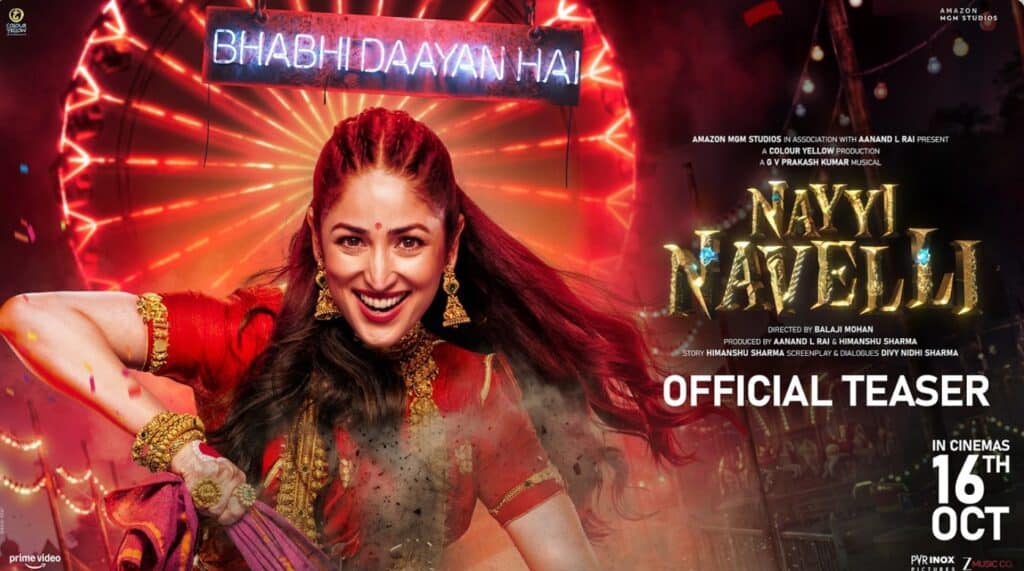
The promotional imagery captures the intended tone perfectly: Yami Gautam in vivid red, smiling amid festive lights while mythical creatures and a multi-headed figure loom nearby. It promises spectacle, domestic humour, and a touch of the supernatural. What audiences actually encounter is a film that begins with the rhythms of a small-town family comedy before pivoting hard into high-decibel mythology. Runtime sits around two hours and eighteen minutes, certified UA16+, with music by G.V. Prakash Kumar marking his Hindi debut in a substantial capacity. Early box-office numbers show a modest opening—roughly ₹3.25 crore India net on day one across more than 6,000 shows, rising somewhat on Saturday to push the two-day India net near ₹7–7.5 crore and worldwide gross toward ₹10 crore. Against a substantial budget and competition that included Rajinikanth’s Jailer 2, these figures already indicate an uphill battle.
Table of Contents
The Premise and Early Setup
The story opens amid preparations for the wedding of Pinky Bua within the sprawling Awasthi household in Meerut. Raja Awasthi, played by Adinath Kothare, is preoccupied with the sudden absence of his new wife Mohini. His younger brother Bantu, portrayed by Anurag Thakur, has taken matters into his own hands after following Mohini into a forest and witnessing what he interprets as a ritual. He locks her away and gathers the extended family—complete with Tau Ji, Asha Devi, Sumitra Tai, Dadi, and assorted uncles and aunts—to announce that their ideal sister-in-law is, in fact, a daayan.
Bantu’s evidence draws from a series of suspicious incidents. Raja recounts meeting Mohini at an office party where their boss dies shortly after an encounter involving her. Other men around Mohini suffer misfortunes—one loses the ability to speak. Meanwhile, the family credits her with bringing order and good fortune: she helps arrange Pinky Bua’s match with an IAS officer named Vishal, restores domestic harmony, and generally behaves like the ideal modern bahu who also happens to be the country head of a company. The women of the household adore her; the men grow increasingly wary as Bantu’s accusations mount. A priest is summoned, mantras are chanted, and sindoor or kumkum is thrown in classic exorcism fashion. None of it works as expected.
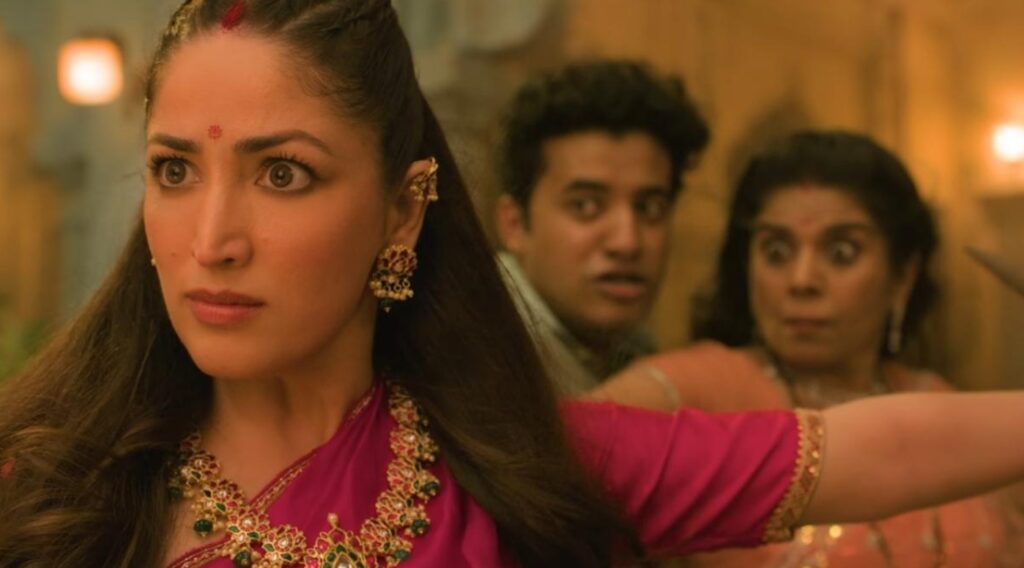
Scenes like the one above show Mohini in a sharp pink outfit, her expression intense while family members react with a mix of fear and disbelief behind her. These early stretches lean into the comic potential of a large joint family reacting to supernatural suspicion. The dialogue carries the earthy flavour of small-town Uttar Pradesh, and Anurag Thakur’s Bantu delivers much of the humour through his dogged insistence and exaggerated reactions. Reviewers have frequently singled out this portion as the film’s strongest: the domestic chaos feels lived-in, the suspicion generates genuine curiosity, and Yami Gautam projects both warmth and an underlying otherworldliness that keeps viewers guessing.
The Mythological Pivot
Once the spells fail to expose Mohini as a witch, the narrative shifts. She reveals herself as a follower of Lord Rama and a descendant of Mandodari, Ravana’s wife from the Treta Yuga. The real threat is not her but Ravana himself, who has taken possession of Raja. The key object is the Kaal Sheel—or Kaalsheel—a powerful stone originally belonging to Mayasura. Ravana seized it, and after his defeat it passed through Mandodari’s line with the duty of protecting it and shielding women from predatory men. The Awasthi house sits on the ancient site associated with Mandodari, and Raja’s horoscope and birth details (including a leap-day birthday) align with conditions that allow Ravana’s power to peak around Dussehra.
Mohini admits she entered Raja’s life deliberately to locate and safeguard the stone, yet she genuinely fell in love with his gentler human self. The stone was stolen from the property. On Dussehra its power intensifies, enabling Ravana to manifest fully—complete with multiple heads representing vices—and threaten wider destruction. Supporting figures include a relative named Sumitra who aids the antagonist, night-crawlers or zombie-like beings possessed by Ravana’s influence, and a brief journey for the family that includes watching a Ram-Leela before they return to confront the crisis. Mohini ultimately draws on Rama’s aura, wields a bow, and delivers the decisive arrow that frees Raja.
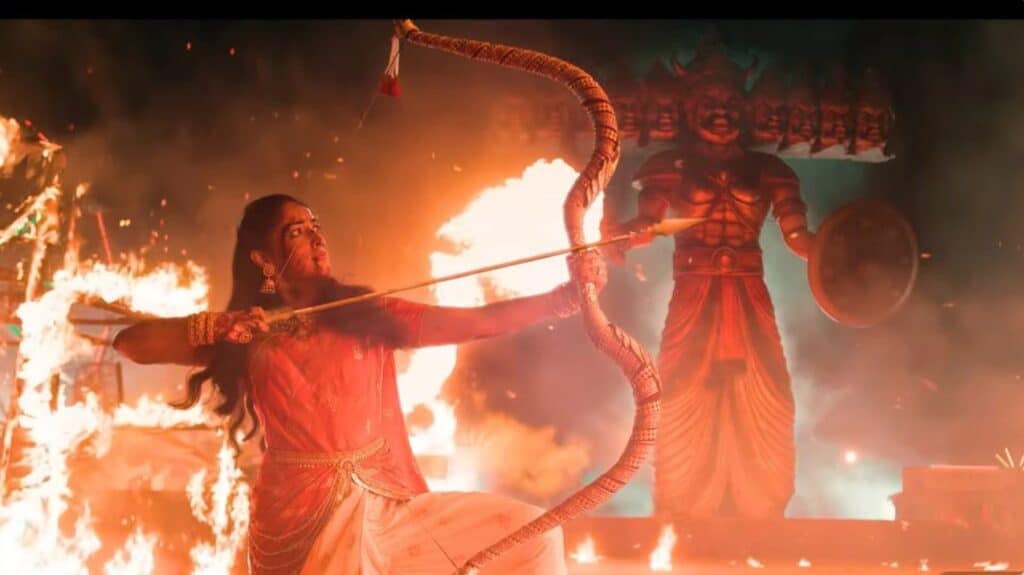
The still of Mohini drawing a large, ornate bow amid flames, with a towering multi-headed Ravana figure behind her, captures the scale the second half aims for. Another image shows her holding a glowing, stone-like object with blood on her face and jewellery, underscoring the high-stakes mystical confrontation.
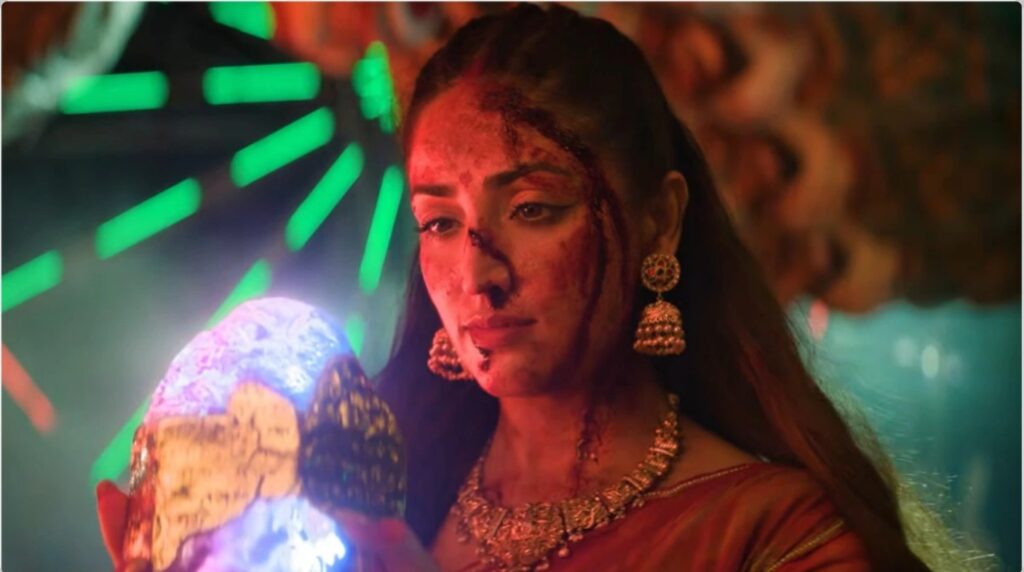
This pivot is where critical consensus turns sharply negative. Many reviewers note that the first half’s grounded family comedy and the social observation about labelling confident or independent women as “daayan” carry real promise. Once the film commits to the Ramayana-inspired lore—complete with mantras, Lakshman Rekha references, Treta Yuga flashbacks or visions, and a climactic good-versus-evil battle—the tone becomes uneven. Exposition increases, logic strains, and the comedy largely evaporates. CGI for the mythological sequences and creatures is frequently described as mediocre or unconvincing. The result, according to multiple outlets, feels like two different films stitched together: one that might have worked as a sharp small-town horror-comedy, and another that turns into an overwrought, noisy crash-course in reimagined mythology.
Shubhra Gupta of The Indian Express awarded one star, arguing the film begins with potential that is comprehensively squandered through scattered writing and execution. Saibal Chatterjee at NDTV gave two stars, observing that talk overshadows action and logic drowns in clashing decibel levels. Other notices from The Hindu, Scroll.in, and Hollywood Reporter India similarly highlight the genre-neutral confusion, the loss of the stronger domestic material, and the sense that invoking gods and epic battles cannot compensate for weak connective tissue. A minority of voices, including some audience reactions on social platforms and a few trade-friendly write-ups, praise the festive energy, Yami’s versatility, Anurag Thakur’s comic timing, and the sheer ambition of blending folklore with family drama. Average critical scores hover in the 1.5-to-2.5 range out of five.

Performances That Carry the Load
Yami Gautam shoulders the bulk of the narrative. As Mohini she moves between the composed, efficient modern professional, the warmly manipulative new bahu who rearranges family dynamics, and the fierce warrior-guardian who eventually takes up arms. Early scenes allow her to display both charm and an unsettling intensity; later ones demand physical commitment in action and ritual sequences. Critics and viewers largely agree she remains committed even when the writing leaves her with repetitive reactions or sudden tonal shifts. Her screen presence keeps the film watchable longer than the screenplay alone might justify. This marks another outing for Gautam in a role that mixes strength with mystery, following recent work that has leaned into more intense or national-themed characters.
Direction, Writing, and Technical Execution
Balaji Mohan’s direction keeps the early Meerut sequences lively and observational, drawing on the kind of joint-family texture familiar from other Colour Yellow productions. Once the mythology dominates, the film loses shape. Screenplay duties fall to Divy Nidhi Sharma from a story by Himanshu Sharma; the structure relies heavily on flashbacks and exposition to bridge the two halves. Dialogues are serviceable in the comic portions but grow declamatory later. Editing by Sumeet Kotian struggles to smooth the abrupt genre leap, and the second half’s pacing slows under the weight of lore. Cinematography by Rishi Punjabi serves the domestic interiors adequately and aims for scale in the fantasy set-pieces, yet the overall visual effects budget shows its limits in the creature and battle work.
The decision to time the release with Dussehra is thematically logical—the climax involves Ravan dahan imagery and the peak power of the Kaal Sheel—but it also invites comparison with more polished festive spectacles. The film includes the now-standard disclaimer distancing itself from promoting occult beliefs while still trafficking heavily in them. Some viewers appreciate the attempt to weave a feminist undercurrent (a confident woman is scrutinised and labelled dangerous by male family members) into the larger mythological frame; others feel that angle is thoroughly overshadowed once the epic battle takes over.
Music and Soundtrack
G.V. Prakash Kumar’s score supplies energetic, desi-flavoured tracks that match the film’s intended hybrid tone. Singles include “Bhabhi Tabaahi” sung by Neeti Mohan, “Phata Patakha” by Madhubanti Bagchi, the instrumental/theme piece “The World of Nayyi Navelli,” and “Awadhiya Ke Raja” by Shreya Ghoshal, with lyrics largely by Vayu. The numbers lean into playful, high-energy arrangements with chorus elements and regional flavour. They function well in promotional contexts and during lighter sequences, though the overall album has not been widely hailed as a standout. Background scoring supports both the comic beats and the louder mythological confrontations, contributing to the “high on decibels” quality several critics noted.
Themes, Cultural Context, and Audience Fit
At its core Nayyi Navelli tries to juggle several ideas: the everyday suspicion directed at women who do not fit the coy, submissive template; the protective legacy passed through generations of women linked to epic figures; the corruption that a powerful object can unleash when it falls into the wrong hands; and the festive reenactment of good triumphing over evil. The Meerut setting grounds the story in recognisable joint-family dynamics, complete with matchmaking, generational quirks, and the pressure of maintaining appearances. The Ramayana overlay allows for spectacle and a clear moral resolution, yet it also risks reducing complex domestic observation to a vehicle for larger-than-life action.
Box-Office Trajectory and Commercial Outlook
Early collections confirm a soft start. Trade reports place day-one India net in the ₹3.18–3.25 crore range, with occupancy around 10–11 percent. Saturday showed growth in some estimates (toward ₹4 crore) despite fewer shows, lifting the two-day India net to roughly ₹7–7.5 crore and worldwide gross near ₹10 crore. Against a budget cited as high as ₹50 crore and in a weekend dominated by larger releases, these numbers position the film as an underperformer. Word-of-mouth from mixed-to-negative critical and early audience reactions will determine whether it holds or fades further into the week. For a film relying on theatrical family viewing during a major festival, the modest opening already signals limited commercial upside.
Final Assessment
Nayyi Navelli is an ambitious but uneven attempt to fuse a small-town family comedy about a suspected daayan with a full-scale Ramayana-inspired fantasy climax. Yami Gautam delivers a committed central performance that keeps individual scenes engaging, Anurag Thakur supplies reliable comic energy, and the early Meerut household sequences generate genuine curiosity and humour. Once the Kaal Sheel, Ravana’s possession, and the Dussehra battle take over, however, the film’s writing, tonal control, and visual execution falter. The result is a noisy, often confusing experience that squanders much of its initial promise. Viewers drawn to Yami Gautam’s presence or willing to embrace unpolished festive spectacle may extract some enjoyment; most others will likely find the second-half mythology overwhelms rather than elevates the material. In a crowded Dussehra weekend, Nayyi Navelli ultimately registers as a missed opportunity rather than a satisfying genre hybrid.
follow me on SPOTIFY As Discovering With Dev