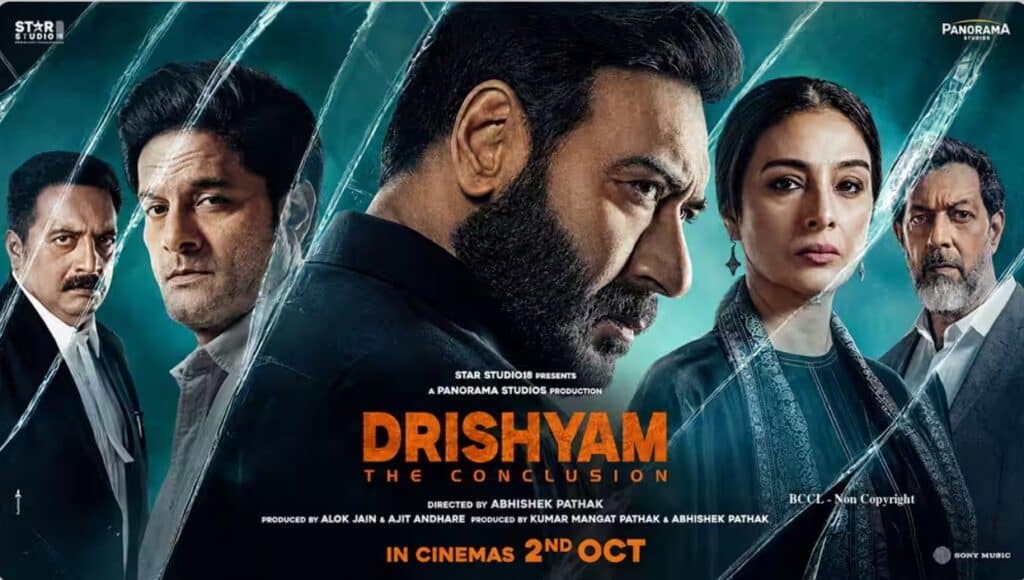
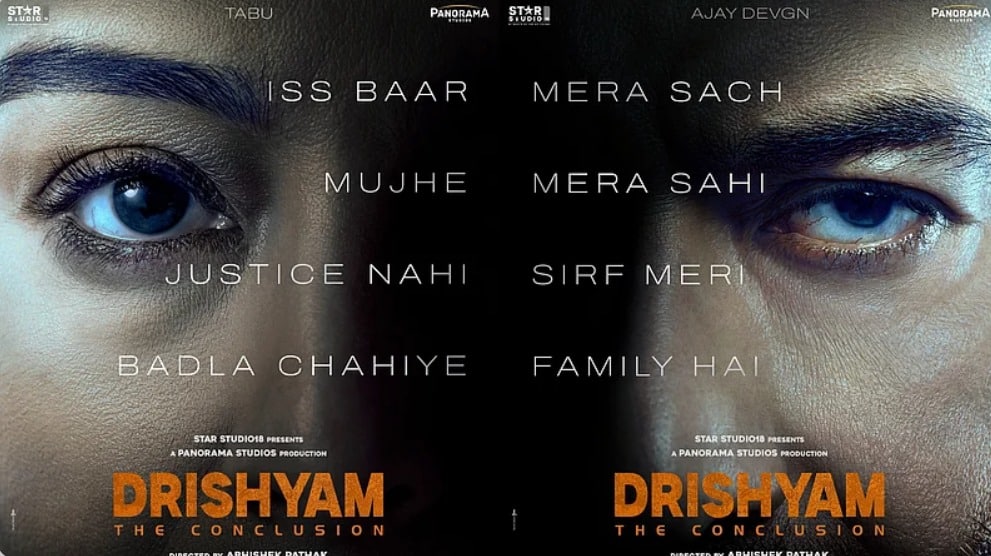
Drishyam 3 The Conclusion arrives as the film the Hindi franchise has been promising since the ashes changed hands at the end of the second chapter. Released in theatres on 2 October 2026, Gandhi Jayanti, it brings Ajay Devgan back as Vijay Salgaonkar and Tabu back as Meera Deshmukh, then hands the investigation to a new Crime Branch officer played by Jaideep Ahlawat. The official title is Drishyam: The Conclusion. Audiences have already shortened it to Drishyam 3. Both names belong to the same film, and both names matter for anyone trying to separate this Hindi finale from the Malayalam Drishyam 3 that opened earlier in the year.
That separation is the first thing worth understanding. Unlike the 2015 Hindi remake and the 2022 sequel, this chapter is not a narrative copy of Jeethu Joseph’s Malayalam third film. Abhishek Pathak, who also directed the Hindi Drishyam 2, co-writes, produces and directs an original story. Principal photography ran from December 2025 to June 2026, mainly in Mumbai and Goa. Panorama Studios and Star Studio18 produce. Star Studio18 handles the India release, with Zee Studios among the overseas partners. The Central Board of Film Certification cleared it with a UA 16+ certificate. Runtime listings are not perfectly aligned: the certification trail cited by trade coverage puts the cut at 2 hours 30 minutes, while the film’s reference page lists 150 minutes. Either way, this is a long sit, built for people who already know the wall, the police station, the cinema hall and the October 2 alibi.
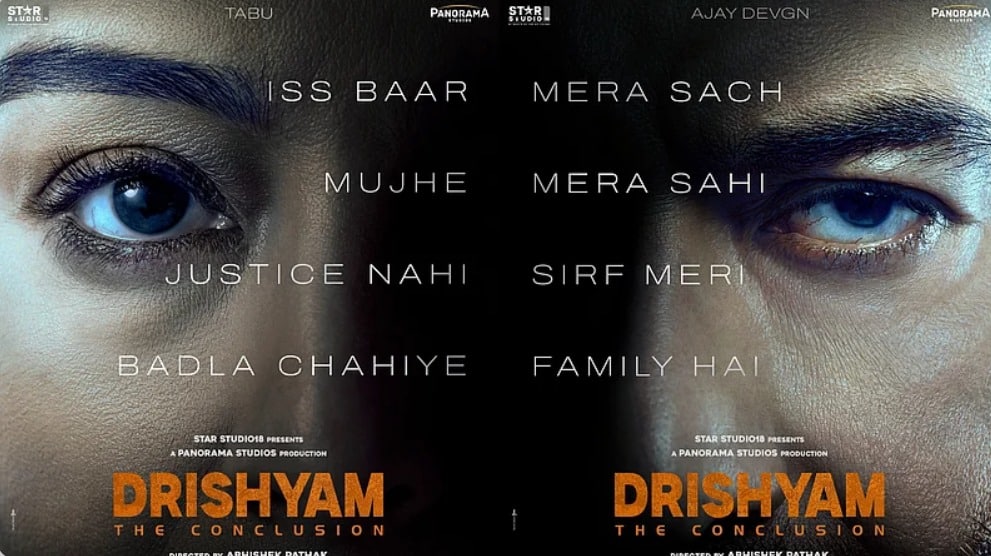
Early reviews do not agree on how well that length is used. Trade commentator Taran Adarsh scored it 4.5 out of 5 and called it the best film in the franchise. The Week landed at 4. CineTales also sat at 4. The Times of India and Cinema Express settled at 3.5. The Indian Express, NDTV, Hindustan Times and India Today clustered at 3. Rediff was cooler at 2.5. That spread is the honest shape of the opening conversation. Drishyam 3 The Conclusion is not a collapse, and it is not a unanimous coronation. It is a confident, talky, sometimes over-scored finale that knows exactly which audience it is speaking to, and that audience showed up.
Table of Contents
Why this ending had to exist
The Hindi Drishyam films have always sold a particular fantasy. An ordinary man who watches too many movies can out-think the state if the thing he is protecting is his family. Vijay Salgaonkar is a cable operator who becomes a cinema owner. He is not a cop, not a lawyer, not a man with political cover. His advantage is patience, film grammar and a refusal to panic in front of people who expect panic. That idea made the 2015 film a crossover hit and made the 2022 sequel feel like a delayed argument rather than a cash-in.
Drishyam 2 ended with the forensic case compromised and with Vijay handing over what the story presents as Sam’s ashes. Meera and Mahesh performed the last rites. The case looked closed. The face on Meera did not. A franchise that leaves a grieving mother with an unanswered doubt is a franchise that has already written its next film, whether or not the writers have finished the pages. Drishyam 3 The Conclusion is that next film. Ten years after Sameer Deshmukh’s disappearance, the Salgaonkars are trying to re-enter ordinary life. Anju is still in therapy. A marriage proposal is on the table. The cable business has grown. Then a new officer reopens the file.
The date on the poster is not a marketing coincidence. October 2 has been part of Vijay’s original alibi since the first film. Releasing the conclusion on Gandhi Jayanti folds the calendar of the story into the calendar of the release. It is a small piece of franchise craft, and it works.
What the third film actually does
Public plot descriptions, including the film’s reference summary, place the story a decade on. Vijay wants the family back inside society. The pressure point is Anju’s proposed match. SP Rajveer Singh Tomar of the Crime Branch does not accept the folk-hero version of Vijay. He treats the old file as solvable. Fresh physical evidence, surveillance, and a willingness to spoil the marriage alliance are his opening moves. Meera Deshmukh and Mahesh return and align with the investigation. The case stops being a local police puzzle and becomes a prosecution. Public prosecutor Indrajith Shetty, played by Prakash Raj, takes the legal attack as far as excavating suspected burial ground.
From there, Vijay stops relying only on the passive cover-up that defined the first two films. He builds a new chain of misdirection and legal counters. The ending, which this review will not unpack beat by beat, turns on him absorbing the liability in a way designed to keep Nandini, Anju and Anu outside the prosecution. Critics who like the film describe that final stand as fulfilling. Critics who do not say the denouement asks the audience to accept too much on faith. Both reactions can be true of a Drishyam climax. These films have always asked viewers to enjoy the carpentry more than the legal realism.
Shubhra Gupta’s Indian Express review, rated 3 out of 5, frames the moral balance cleanly. The film does not erase the stunned grief of the dead boy’s parents, and it does not abandon the Salgaonkars to a mushy courtroom speech. The pronouncement arrives after a sharp exchange between junior defence lawyer Gayathri Mohan, played by Samvedna Suwalka, and a crestfallen Shetty. Gupta calls that landing a vindication, and calls the film a conclusion that also feels like a beginning. India Today’s Sana Farzeen, also at 3, is less convinced that the final curtain earns the word “final.” The twists hold. The plotting holds. The aftertaste, for that review, is “was that it?”
A viewer deciding whether to buy a ticket should treat those two lines as the live argument, not as a contradiction to be resolved by a third review. Drishyam 3 The Conclusion is engineered so that people who want Vijay to win can feel the win, and people who want the law to mean something can still hear Meera’s case. Whether both sides leave satisfied depends on how much courtroom theatre a person is willing to accept as closure.
The cast, and the officer who was not supposed to be here
Ajay Devgn plays Vijay the way the franchise needs him played: still, slightly amused, never in a hurry to explain himself. The performance is not a reinvention. It is a continuation, and continuation is the job. Critics across the board describe him as solid, unflappable, cinema-obsessed, always placed two steps ahead of the room. The slo-mo walk back toward the lens is still part of the grammar. What changes is the stake. In the first film he was inventing an alibi under panic. In the second he was managing a cold case and a published story. Here he is managing a family that has lived inside the lie long enough for the lie to become a marriage problem, a therapy problem and a public myth. Devgn’s best moments are the ones where calculation shows as tiredness rather than as a speech.
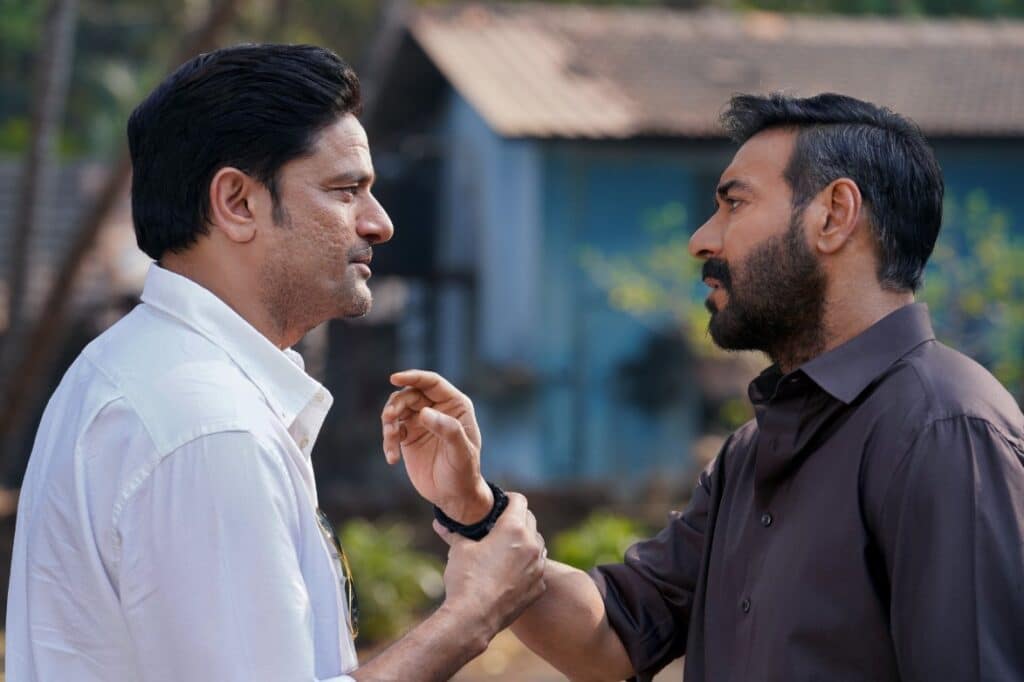
Jaideep Ahlawat is the variable the production did not plan for. Akshaye Khanna was set to return from Drishyam 2 and later exited over creative and financial disagreements. Pathak has described the exit as an unwelcome jolt rather than a panic, followed by a rewrite and a late look test. Ahlawat has been clear in interviews that SP Rajveer Singh Tomar is not a renamed version of Khanna’s Tarun Ahlawat. He is a new officer with his own brief. Early audience posts have been loud about the performance. Several opening-day reactions argue that the first half belongs to him, and that the aggression would not have sat the same way on the earlier investigator. Shubhra Gupta’s line is the neatest critical summary: Ahlawat’s jaunty tilt means you do not spend the film missing the smirk from part two. One image from her review has already travelled: a plate of jalebi that will not read as innocent again.
That recasting is also a useful lesson in how a franchise absorbs a hole. Tomar is written as a man who wants to break a myth, not merely close a file. He surveils. He interferes with Anju’s match. He treats Vijay’s public reputation as evidence of manipulation rather than as proof of innocence. The film is most alive when Devgn and Ahlawat share a frame and neither man raises his voice to win it. Audience posts calling the climax stronger than the first two films are doing what opening-day posts always do. They are also pointing at the real contest. This movie is a duel, not a reunion special.
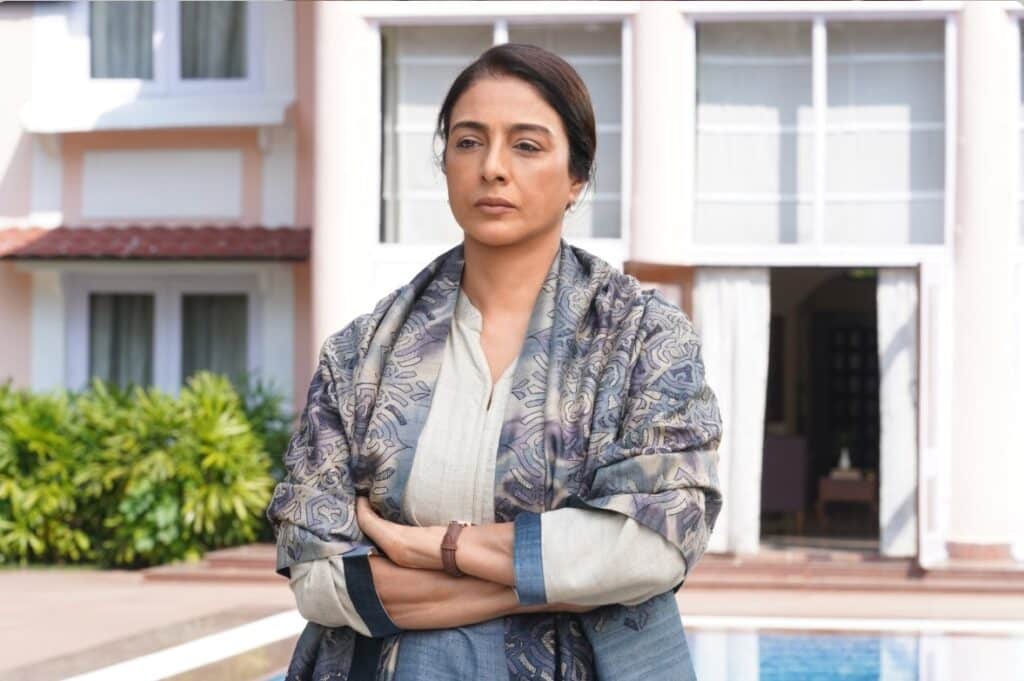
Tabu remains the film’s moral centre, even when the plot hands the procedural work to other people. Meera is no longer the serving IG driving a raid. She is a former officer and a mother who has lived with an absence the courts have not been able to name. Gupta writes that the wounded eyes are the image that stays: a mother unable to comprehend a world that does not contain her only child. CineTales makes a similar point from the other direction. The grief is powerful without tipping into melodrama. That is a hard calibration. Meera could have been written as an obstacle the hero has to outwit. The better reviews argue that the film remembers she is also the person the first crime damaged.
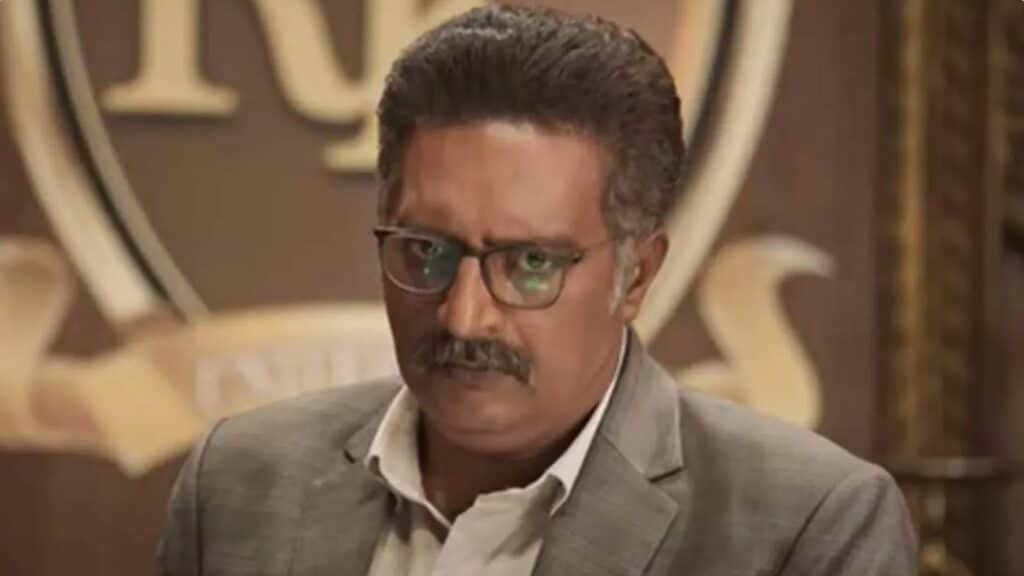
Prakash Raj’s public prosecutor, Indrajith Shetty, is the other new pressure point. He does not investigate. He prosecutes. Reviews describe him as thundering effectively and giving the courtroom its authority. The excavation of suspected burial ground is the image that tells you what kind of third film this is. The first Drishyam hid a body. The second Drishyam argued about bones and DNA. The third Drishyam digs. Shetty is the man willing to turn the landscape into evidence. Samvedna Suwalka’s Gayathri Mohan is the defence voice on the other side of those exchanges, and the reviews that praise the ending tend to praise that clash.
Saurabh Shukla returns in the orbit of Murad Ali, the screenwriter figure who understands how Vijay thinks because Vijay thinks in scenes. The supporting bench also includes Yogesh Soman, Rajiv Gupta and a run of Goa-side characters who keep the film from floating off into abstract legal theory. This is still a story about a house, a road, a police station and a court.
Direction, writing, and the choice not to copy Kerala
Pathak’s decision to leave the Malayalam third film alone is the production fact that will age best. Jeethu Joseph’s Drishyam 3, starring Mohanlal, opened on 21 May 2026, on the star’s birthday, after a delay tied to the 2026 Iran war. It ran about 160 minutes and collected roughly ₹237.70 crore. Reviews at home were mixed, with a common complaint that the sequel felt forced. Pathak’s film does not try to dub that reaction into Hindi. Sajin Shrijith in The Week argued that the Hindi chapter is stronger precisely because it chooses its own narrative. Sukanya Verma at Rediff made the comparison from the other side and found the Hindi Vijay less evolved than Georgekutty, whose guilt, in that reading, gets monetised into personal ambition. The disagreement is useful. One critic rewards originality. The other asks whether originality produced a deeper man.
The writing credit sits with Pathak, Aamil Keeyan Khan and Parveez Shaikh, with dialogues by Khan. The story is Pathak’s. That matters because the earlier Hindi films were remakes. A remake can hide inside a structure the audience already trusts. An original finale has to invent the trust. The invention here is procedural. Tomar’s surveillance, Shetty’s excavation, the marriage alliance as a point of leverage, and Vijay’s shift from cover-up to legal counter-attack are the new tools. The old tools are still in the box: a family that has rehearsed a story, a hero who has watched enough films to know how investigators watch films, and a mother who will not accept a ritual as a verdict.
The middle stretch is where the cooler reviews lose patience. CineTales calls the middle talkative, busy explaining the investigation, and says the edit could have been tighter even while praising the build. The Times of India notes that the film sticks to the franchise template and drags toward the end. Hindustan Times finds drama and nostalgia, then asks the audience to take too much at face value. NDTV’s Saibal Chatterjee describes a taut script that leads to a denouement some viewers will find flummoxing. Variety India is blunter about the cat-and-mouse game: less entertaining than before, short on novelty. These are not minor complaints. They describe the risk of a third film in a series whose trick is already famous. Once the audience knows that Vijay has another version of events ready, tension has to come from somewhere other than surprise. Pathak looks for it in legal exposure and in Anju’s life being interrupted again. Some viewers feel that search. Some feel the explanation.
How it looks, how it sounds, how long it feels
Sudhir K. Chaudhary’s cinematography stays inside the franchise’s grounded look. Goa is not turned into a postcard. The road, the house and the institutional rooms do the work. Reviews that mention the image say it avoids exaggeration, which is the right choice for a film whose suspense is conversational. Sandeep Francis edits. The argument about length is really an argument about the middle. A 150-minute or 150-plus cut can hold a mystery if every explanation changes the power in the room. It sags when the explanation repeats a power shift the audience has already understood.
The score is Amar Mohile’s. The songs come from Ravi Basrur, Rochak Kohli and Karma, with lyrics by Manoj Muntashir, Aamil Keeyan Khan and Karma. Sony Music India released the soundtrack on 28 September 2026. It runs 14 minutes 54 seconds. “Vingansa,” sung by Siddharth Basrur, arrived on 17 September. “Muskura Do,” sung by Lucky Ali and composed by Kohli, arrived on 23 September and is the family song, the one that steps away from the case. “Daastaan – The Drishyam Recap,” sung by Sunidhi Chauhan, does what its title says. “Game Over,” sung by Karma, closes the set on 28 September. CineTales finds Basrur’s tension score effective when it stays restrained and blunt when the stakes spike. Gupta’s complaint is the modern one: even a confidently told film reaches for ear-shattering background music instead of trusting the scene. Both notes can sit together. The songs are short and functional. The score is the thing that will annoy people who wanted the silences of the first film.
Who this film is for
It is for people who can retell the wall, the police station and the ashes without a recap video. The callbacks are a feature, not a garnish. India Today’s audience roundup makes that point: viewers who know the first two films are the ones calling the twists rewarding. A new viewer can follow the plot. A new viewer cannot feel why a marriage proposal under surveillance is cruel, or why a plate of food in an interrogation room carries a joke.
It is also for people who like their thrillers spoken. There is pressure, there is excavation, there is a courtroom, and there is very little of the set-piece action that currently dominates Hindi event cinema. The thrill, as more than one review notes, comes from watching people think. That will read as adult filmmaking to one audience and as a talky middle to another. Both descriptions fit the same cut.
It is a poorer fit for anyone hoping the conclusion will morally retry the original crime and hand down a clean civic lesson. The film stays inside the franchise’s bargain. The parents’ grief is visible. The family’s fear is visible. The victory, if it is a victory, is still a constructed one. Gupta’s line that the ending feels like an ending and a beginning is the most precise description available on day one. Closure here does not mean innocence. It means the case, as a case, has been forced to stop.
Verdict
Drishyam 3 The Conclusion does the job a finale is supposed to do when the series is a family argument rather than a mythology. It brings the old faces back, gives the new investigator a real brief, and refuses to pretend the Malayalam third film already solved the Hindi problem. Ajay Devgan is exactly as controlled as the role now requires. Jaideep Ahlawat makes the recasting feel like a gain. Tabu keeps the grief from becoming background. Prakash Raj gives the second half a voice loud enough to threaten the hero’s quiet. somewhere between a 3 and a 4 depending on how much courtroom carpentry a viewer is happy to call justice.
Seen as a Drishyam 3 review rather than as a referendum on the whole series, the film earns the ticket. Seen as the last word on Vijay Salgaonkar, it earns something rarer. It lets the audience leave with the family still intact and the mother’s question still audible. That is not a perfect ending. For this franchise, it is an honest one.
Quick facts
- Title: Drishyam: The Conclusion, widely called Drishyam 3
- Director: Abhishek Pathak
- Writers: Abhishek Pathak, Aamil Keeyan Khan, Parveez Shaikh
- Producers: Kumar Mangat Pathak, Abhishek Pathak, Ajit Andhare, Alok Jain
- Cast: Ajay Devgn, Jaideep Ahlawat, Tabu, Shriya Saran, Rajat Kapoor, Prakash Raj, Ishita Dutta, Mrunal Jadhav, Kamlesh Sawant, Saurabh Shukla, Samvedna Suwalka
- Release: 2 October 2026
- Certificate: UA 16+
- Runtime: about 150 minutes, with certification reports citing 2 hours 30 minutes
- Music: Ravi Basrur, Rochak Kohli, Karma; score by Amar Mohile
follow me on SPOTIFY As Discovering With Dev