
Christopher Nolan does not make small films. After bending time in Inception, stretching space in Interstellar, and dissecting genius and guilt in Oppenheimer, the director has turned to one of the oldest stories still being told: Homer’s Odyssey. Released in July 2026 and often searched online as “Odessey,” the film is a 173-minute mythic action epic shot entirely on IMAX 70mm film cameras — the first feature in history to do so. For Indian audiences who packed IMAX halls for Oppenheimer and still quote Interstellar years later, this is not just another Hollywood release. The Odyssey Movie Review 2026 is an event.
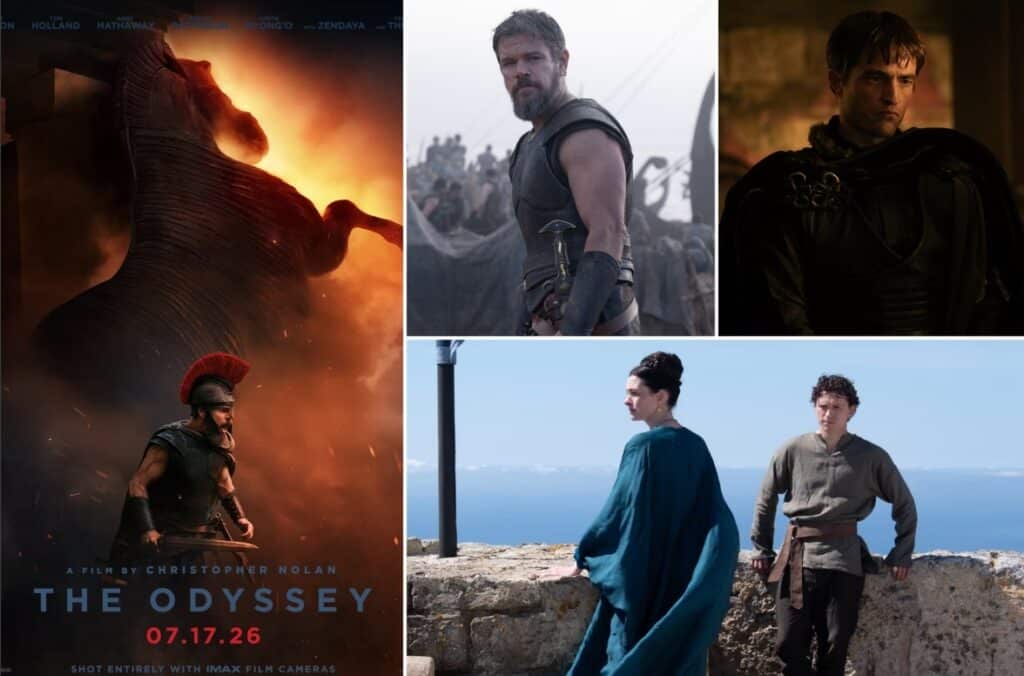
The story is simple on paper and enormous on screen. Odysseus, king of Ithaca, has been gone twenty years — ten fighting at Troy, ten trying to get home. His wife Penelope holds the palace together while suitors circle. His son Telemachus grows up without a father. The sea, the gods, monsters, and Odysseus’s own choices stand between a man and the only place that still means home. Nolan keeps the bones of the poem and adds his signature obsessions: time, memory, the cost of cleverness, and the question of whether a hero can ever really return.
Indian viewers have responded to that question with unusual intensity. Homecoming, waiting families, gods who intervene and punish, a king who must prove he is still worthy of his house — these are not foreign ideas here. They sit close to the Ramayana and countless family sagas that still fill theatres. That cultural echo, plus the sheer physical scale of the images, explains why The Odyssey became one of the year’s most discussed Hollywood films in India.
Table of Contents
What The Odyssey Is Actually About (Without Ruining the Journey)
The film opens on Ithaca after two decades of absence. Penelope (Anne Hathaway) weaves and unweaves, buying time. Telemachus (Tom Holland) is no longer a boy; he is a young man trying to protect a household that no longer feels like his. The suitors, led by a magnetic and dangerous Antinous (Robert Pattinson), treat the palace as already theirs. Faithful servants still believe the king will return. Most people have stopped believing.
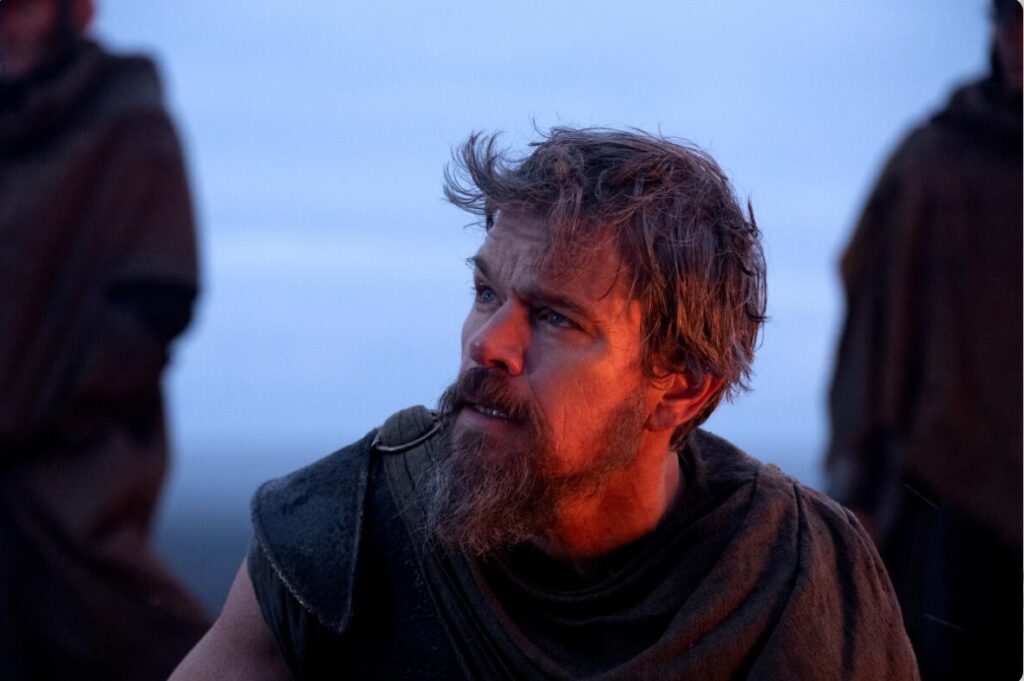
Meanwhile Odysseus (Matt Damon) is far from home, weathered, half-remembering, and still paying for the cleverness that won the war. The famous episodes arrive not as a checklist but as lived ordeal: the Cyclops, Circe, the Sirens, Calypso’s island, the underworld, storms that feel like the sea itself has taken a side. Nolan intercuts the voyage with Ithaca so the audience never forgets what is at stake. The structure is not strictly linear. Memory, vision, and present action bleed into one another the way they do in Nolan’s earlier work, but here the emotional through-line is clearer than in Tenet or even Inception.
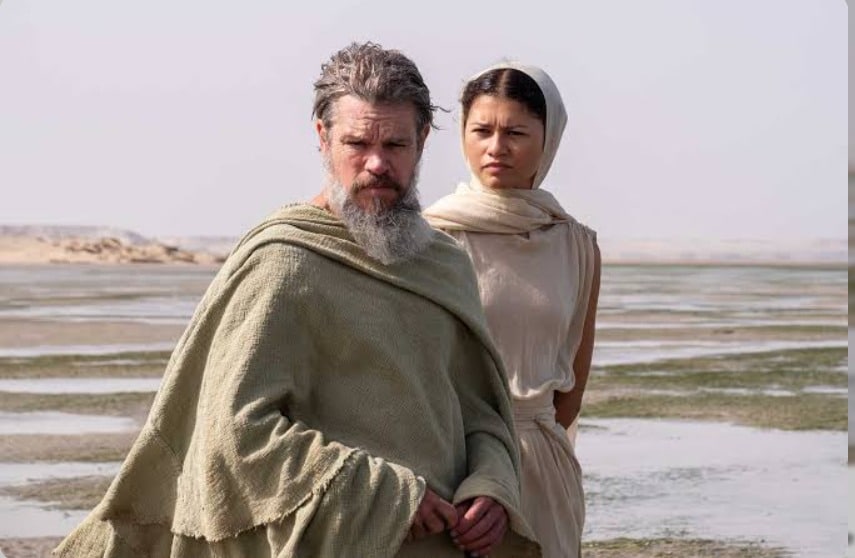
The film does not treat the gods as comic-book figures. Athena (Zendaya) appears as presence, counsel, and sometimes accusation. Calypso (Charlize Theron) is both jailer and temptation. The divine feels like weather and conscience rather than special-effects cameos. That choice keeps the story human even when the images become mythic.
Runtime is 173 minutes. The R rating covers violence and some language. The film is demanding in the way Nolan films usually are: it expects attention, rewards a second viewing, and does not explain every symbol. Viewers who come only for “action scenes with monsters” may find stretches of quiet that feel long. Viewers who come for a story about a man trying to get back to his family usually stay with it.
Performances: An Ensemble That Treats Myth Like Drama
Matt Damon is the film’s anchor. His Odysseus is not a gleaming bronze hero. He is tired, cunning, guilty, and still capable of sudden tenderness. Damon has played everymen and survivors before; here he adds the weight of a man who knows the war he helped end also cursed his return. The performance is physical — the body language of someone who has lived too long on ships and islands — and internal. Indian audiences who loved him in The Martian and Oppenheimer have singled out this role as one of his richest.
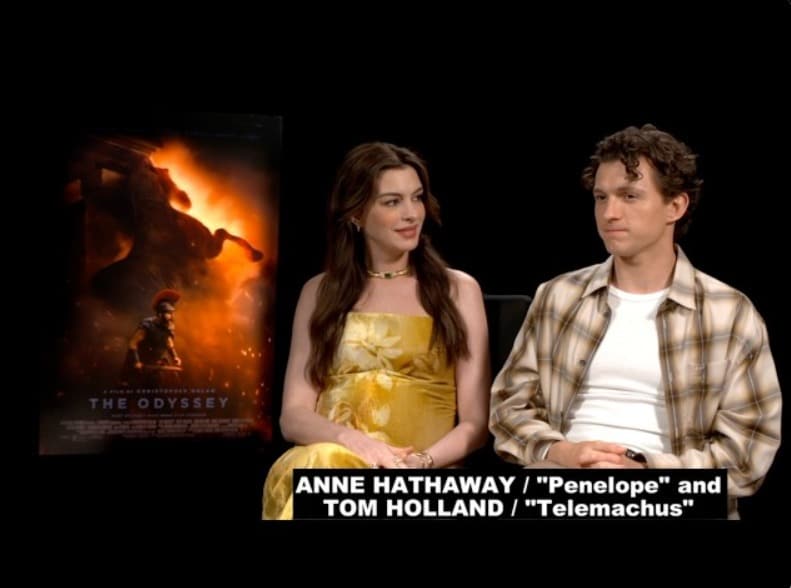
Anne Hathaway’s Penelope is the film’s moral centre. She is not a passive waiting figure. Hathaway plays a queen who has kept a kingdom from collapsing through intelligence, ritual, and sheer refusal to surrender the house. The scenes between Penelope and Telemachus carry the ache of a family that has been incomplete for too long. Tom Holland, often associated with youthful energy, plays a son who is both protective and unfinished. The performance has been widely noted as a step into more adult dramatic territory.
Robert Pattinson’s Antinous is the suitor who understands power as performance. He is charming, threatening, and never quite cartoonish. Zendaya’s Athena is watchful and cool rather than thunderous; the film uses her presence to ask whether the gods help or merely observe the damage men do. Charlize Theron as Calypso, Samantha Morton as Circe, Lupita Nyong’o in a dual role as Helen and Clytemnestra, Jon Bernthal as Menelaus, John Leguizamo as the loyal Eumaeus, and Himesh Patel as Eurylochus fill out a cast that feels expensive and specific rather than crowded for the sake of names.
Supporting turns land because Nolan gives them space. The film is not a star parade; it is a company of actors who understand they are inside a story older than cinema.
Direction, IMAX, and the Look of the Film
Nolan and cinematographer Hoyte van Hoytema shot the entire feature on IMAX 70mm film. That is not a marketing line. It is the reason certain sequences — open sea, fire, the scale of a palace hall, a single human face in a vast landscape — feel different from ordinary blockbusters. Indian IMAX screens are fewer and smaller than the largest 70mm venues, yet even on those screens the image density and contrast have been the most common praise in audience reactions.
Production design by Ruth De Jong and costumes by Ellen Mirojnick keep the world grounded: weathered wood, salt-stained cloth, bronze that looks used. Locations across Morocco, Greece, Italy, Scotland, Iceland, and Malta give the voyage a real geography instead of a green-screen tour. Ludwig Göransson’s score is less immediately hummable than some of his earlier work and more like weather — low, tidal, occasionally erupting. Jennifer Lame’s editing keeps the dual timelines from collapsing into confusion.
The first feature shot entirely this way is also a statement. Nolan has spent a career arguing that certain stories belong on the largest possible canvas with the least possible digital compromise. The Odyssey is that argument made at full volume. Indian viewers who travelled across cities for IMAX slots treated the format as part of the meaning of the film, not an extra.
Themes That Travel Well to Indian Screens
The poem is 2,800 years old. The film’s questions are not. What does a long absence do to a family? Can cleverness that wins a war also destroy the winner? Is home a place, a person, or a set of duties that survive even when the person who left has changed? How do the people who stayed behind keep faith without becoming fools?
Those questions sit comfortably beside Indian narrative traditions. A king delayed by war and divine obstacle, a wife who holds the household through ritual and cunning, a son who must become a man in the father’s absence, suitors who treat hospitality as a right to seize — the pattern is familiar even if the names are Greek. Commentators in Indian media have compared the film’s human scale to what many feel is still missing from some large-scale mythological productions at home: the willingness to let a hero be flawed, tired, and morally complicated rather than only radiant.
Nolan does not lecture. He shows a man who used a wooden horse to end a siege and then spent years discovering that some victories do not stay won. Guilt, hospitality, the treatment of guests and strangers, the cost of pride — these are not imported themes. They are the same themes that have kept epics alive across cultures. That is one reason the film did not feel like “foreign mythology” to many Indian viewers. It felt like a different language for a story they already knew how to feel.
The film also asks what a king owes the people who waited. The ending, which some readers of Homer will notice has been shaped rather than copied, treats return as both gift and reckoning. Without spoiling the last movement, it is enough to say the film is more interested in what “home” costs than in a simple triumph.
Spider-Man: Brand New Day Review (2026): Tom Holland’s Lonely Web-Slinger Grows Up
How India Received The Odyssey
India hosted an early premiere in Mumbai before the global wide release, a rare first for a Nolan film. Opening-day collections were strong for an English-language, R-rated, nearly three-hour epic. The film crossed the ₹100 crore gross mark in its first week and continued a long theatrical life, with IMAX screens contributing a strikingly high share of the total — in some reports close to half over the full run. English prints led; Hindi, Tamil, and Telugu versions existed but did not dominate, which is typical for this kind of Nolan title.
By later weeks the film had collected in the range of ₹180–220 crore plus in India depending on the tracker and whether net or gross is cited, while worldwide it crossed well over a billion dollars and became one of 2026’s biggest films and Nolan’s highest-grossing. IMAX demand stayed high enough that the loss of those screens to a later release became industry news. Exhibitors described audiences treating the film as an experience to revisit rather than a one-time ticket.
Critical scores landed in the mid-to-high 90s on Rotten Tomatoes among critics, with audience scores also very high. IMDb settled in the mid-8s after the usual early volatility. Indian reviewers at The Indian Express, The Hindu, and others praised scale, Damon’s work, and the film’s emotional clarity even when they noted deviations from the poem or a first act that takes time to lock in. Filmmakers including Atlee and Kamal Haasan publicly called it essential big-screen cinema.
The conversation on social platforms mixed awe at the images with debate about fidelity to Homer, the usefulness of prior knowledge of the Trojan War, and whether the film is “slow.” That split is familiar from earlier Nolan releases. The people who stayed with it tended to talk about the last hour and the faces more than the monsters.
Strengths and the Places It Asks Patience
Strengths are obvious: image-making at a level few contemporary films attempt, a lead performance that humanises a legend, a supporting cast that never feels like cameo hunting, and a score and sound design that make the sea feel like a character. The dual structure — voyage and household — gives the film a heartbeat instead of a string of episodes.
The places it asks patience are also clear. The opening stretch can feel measured if a viewer wants immediate spectacle. Some mythological set pieces are more suggestive than fully staged, which will disappoint anyone hoping for wall-to-wall creature features. The film assumes a certain willingness to sit with grief and waiting. It is not a popcorn ride in the conventional sense, even when ships break and halls erupt.
For Indian family audiences used to clearer moral colouring in mythological cinema, Odysseus’s flaws may feel sharper than expected. That is also the point. The film is interested in a hero who is great and also responsible for the length of his own exile.
Who Should Watch The Odyssey in India
Anyone who already likes Nolan should see it on the largest screen available. Anyone who likes epics that treat family as seriously as war should see it. Students who have only met Homer in abridged school versions will find a version that respects the poem without treating it as a museum piece. Viewers who want only light entertainment or a short runtime should look elsewhere.
The film rewards some familiarity with the basic story — Troy fell, Odysseus was delayed, Penelope waited — but it does not require a classics degree. Subtitles help; the English is clear but dense in places. IMAX or the best available large format is the intended version. Regular digital projection still works; it simply loses the reason the film was made the way it was.
Final Verdict
The Odyssey is Christopher Nolan using the oldest adventure in the Western canon to ask questions that still matter in any culture that values home, duty, and the price of leaving. It is spectacular without being empty and serious without being joyless. Matt Damon gives the role a lived-in gravity. The ensemble supports him. The IMAX photography is not a gimmick; it is the language of the film.
Indian audiences have treated it as more than a Hollywood import. They have treated it as a large-scale story about waiting, returning, and what a household becomes when its centre is missing for twenty years. That is why the film lasted in theatres longer than many expected and why IMAX slots became a talking point rather than a footnote.
It is not a perfect translation of Homer. It is a powerful translation of the feeling Homer has produced for centuries: the longing to get back, and the fear that getting back will not be the same as being home.
Rating: 4.5 / 5
The Odyssey is currently in theatres and later expected on premium home formats. For anyone who still believes some stories need a dark hall, a large screen, and three hours of undivided attention, this is the one.
follow me on SPOTIFY As Discovering With Dev