
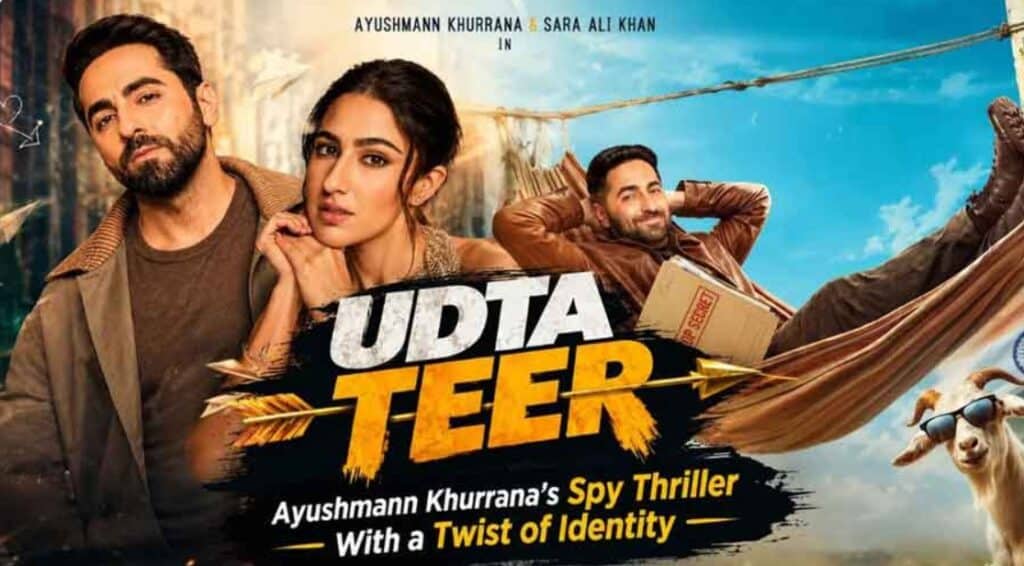
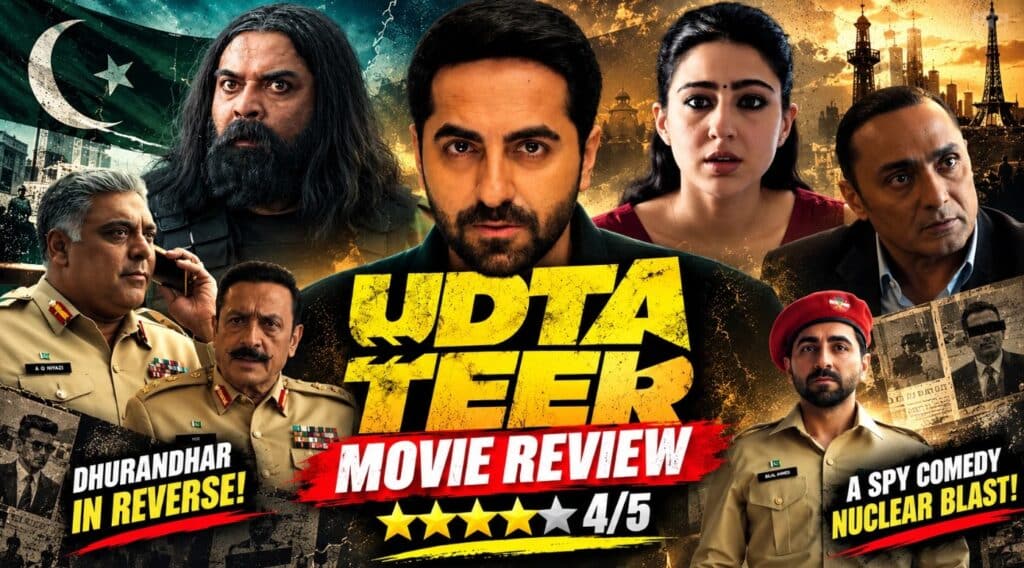
Udta Teer arrives in theatres as one of the more unusual propositions in recent Bollywood. Released on 23 October 2026, this Hindi-language spy comedy is the directorial debut of Aakash Kaushik and pairs Ayushmann Khurrana with Sara Ali Khan under the banners of Dharma Productions and Sikhya Entertainment. The title itself, translating roughly to “Flying Arrow” or “Trouble,” signals the film’s playful intent. Its tagline—“Deshbhakti yaad hai par desh nahi”—captures the central joke with economy: patriotism is remembered, the country is not.
The premise is simple enough to sound like a one-line pitch that could either soar or collapse under its own weight. A Pakistani operative working undercover inside India’s Counter Terrorism Squad loses his memory in an accident and wakes up convinced he is a fiercely patriotic Indian agent. What follows is a cascade of misunderstandings, shifting loyalties, and comic situations that occasionally brush against more serious terrain involving terrorism and intelligence agencies.In this post we will see Udta Teer movie review with all details .
Produced by Karan Johar, Adar Poonawalla, Guneet Monga Kapoor, Apoorva Mehta and Achin Jain, the film marks the fourth collaboration between Dharma and Sikhya after projects such as Kill and Gyaarah Gyaarah. It also carries the distinction of being the second posthumous screen appearance of Mukul Dev, who plays the terrorist figure Azhar Maqsood. Runtime sits around 134 to 137 minutes depending on the source, certified UA, and the theatrical window has already seen the film banned in Nepal and certain Gulf countries over diplomatic sensitivities linked to its cross-border subject matter.
Table of Contents
The Premise and How It Unfolds
At its core, Udta Teer is a comedy of errors set inside the machinery of espionage. Bilal Ahmad (Ayushmann Khurrana), a sleeper agent of Pakistan’s ISI, has successfully embedded himself as Vikrant Thapar inside India’s CTS. He is tracking a high-value target linked to Azhar Maqsood when an accident erases his memory. He retains the training, the reflexes, and the emotional pull of national duty—but the specific nation has vanished from his mind. Those around him, both Indian colleagues and residual Pakistani handlers, begin feeding him information that reinforces whichever identity serves their purpose.
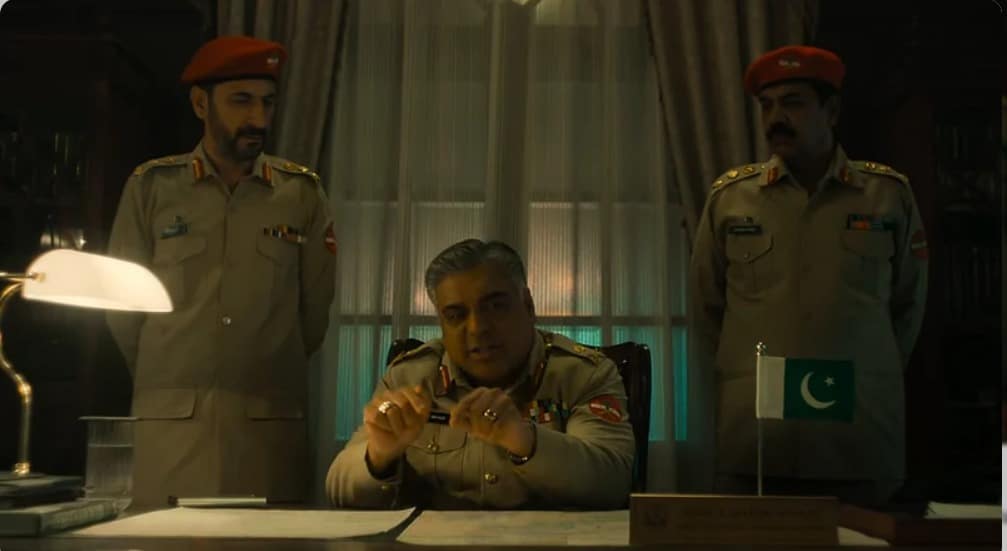
The film opens with threats and intelligence briefings that establish the stakes, then quickly shifts into the domestic and professional life of “Vikrant.” His marriage to Yamini (Sara Ali Khan), who works in a defence-related capacity, is already strained. CTS chief figures, played with comic brio by Rahul Bose, are hunting for a mole. Parallel tracks involve Pakistani handlers who watch in mounting disbelief as their asset starts eliminating their own operatives and waving the Indian flag. One memorable exchange has a handler telling Bilal he has turned into a Sunny Deol-style patriot when he is still, in reality, the other side’s man.

The humour largely derives from situational irony rather than punch-line gags. Audiences know the truth while the central character does not; supporting characters either cannot believe what they are seeing or actively exploit the confusion. Songs by Sachin-Jigar and a score by Ketan Sodha are deployed with varying success—some underscore the absurdity, others feel inserted for commercial reasons. Locations range from Kashmiri terrain to urban Delhi-Mumbai interiors and border-adjacent set pieces, giving the film a visual spread that matches its geographic premise.
Ayushmann Khurrana’s Dual Performance
Khurrana is the clear centre of gravity. He has built a career on roles that sit slightly askew of mainstream heroism, and Udta Teer continues that pattern. Playing both the embedded spy and the amnesiac patriot requires him to modulate conviction, bewilderment, and comic over-commitment without tipping into caricature. Early sequences that establish the double life are handled with a light touch; later scenes in which the character’s new-found patriotism collides with residual handlers produce some of the film’s sharper laughs. Critics across outlets have singled out his comic timing and the ease with which he navigates the identity slip.

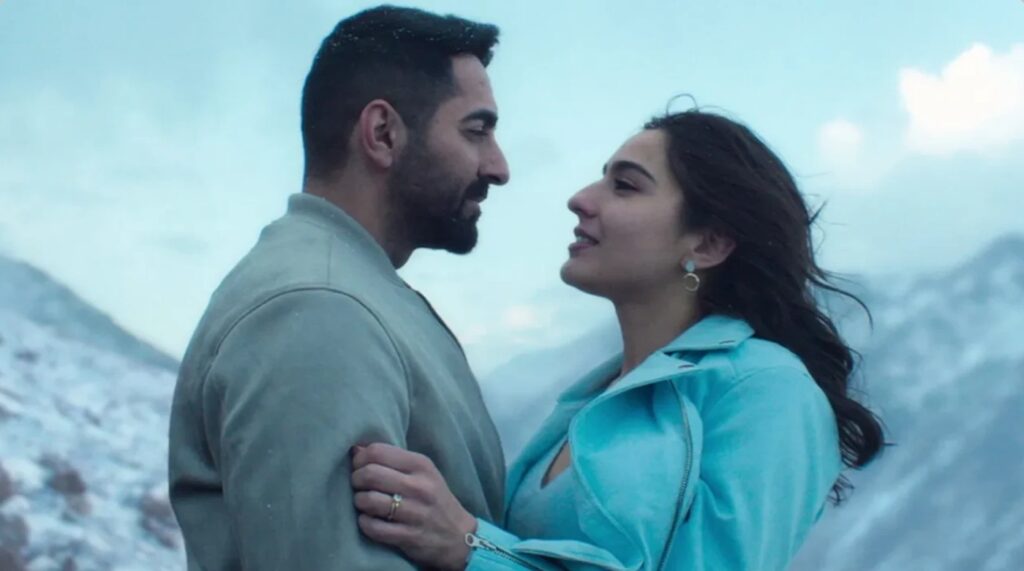
Sara Ali Khan’s Yamini receives less narrative space. She appears in domestic confrontations, a handful of emotional beats, and song sequences, but the screenplay does not develop her as an equal participant in the central confusion. Reviews consistently note the limited scope; her performance is described as competent and photogenic without being given material that lets her stretch. Supporting players fare better. Rahul Bose extracts consistent comedy from his intense CTS chief, often through physical reactions and deadpan responses to escalating absurdity. Suhail Nayyar, as a handler or fellow operative, shares sharp repartee with Khurrana that several reviewers flag as a highlight. Mukul Dev’s Azhar Maqsood is played with relish; his introduction and certain character quirks (including a dating-app obsession in one account) supply unexpected levity. Ram Kapoor, Gulshan Grover, Brijendra Kala, Supriya Pilgaonkar, and Raghubir Yadav fill out the ensemble with reliable character work, though some roles remain thinly sketched.
Direction, Writing, and Tonal Shifts
Aakash Kaushik, previously associated with dialogue and writing on projects including Housefull entries, Thank God, and Bhool Bhulaiyaa titles, makes his feature directing debut. The first half largely trusts the premise. It keeps the audience one step ahead of the protagonist and lets the resulting mismatches generate humour without heavy explanation. Editing by Shivkumar V. Panicker and Prerna Saigal keeps the early sections relatively tight. Cinematography credited to Harshvir Oberai (with additional work noted) captures both the border-adjacent outdoor sequences and the more intimate indoor confusion with workable clarity.
The difficulty arrives when the film attempts to resolve its central joke. Multiple reviews observe a gear shift in the second half: the satirical, almost mockumentary-flavoured approach gives way to more conventional action-spy mechanics and patriotic framing. What begins as an irreverent look at how easily loyalty can be reprogrammed becomes, for stretches, a straighter story about protecting the nation. Some critics find the pivot cautious and commercially motivated; others argue it undercuts the very ambiguity that made the premise fresh. The writing is described as audacious in concept yet uneven in execution—strong on situational comedy, less assured when it must land emotional or thematic payoffs.
Critical Reception and Audience Signals
Aggregate critic scores sit around 4/5 based on a modest number of early reviews. Hindustan Times, India Today, and Filmfare each awarded 3.5, praising the first-half humour, Khurrana’s commitment, and the supporting cast while noting the second half’s complications. Times of India settled at 3.0, arguing that a promising satire loses its nerve. Bollywood Hungama gave 3, highlighting Rahul Bose and Mukul Dev. Higher marks (4 or 4.5) appeared in a couple of outlets that prioritised entertainment value over logic. IMDb user scores hovered near 6.8 in the first days.
Audience reactions on social platforms echoed the split. Some viewers responded to the premise as a “patriotic laugh riot” and singled out Bose’s comic turn; others found the humour dry in places or objected to the logical leaps required once the amnesia plot accelerates. The film’s marketing—trailers released in September and mid-October, border visits by the lead pair, and the hammock-between-milestones poster—generated moderate curiosity rather than feverish anticipation. Advance bookings were respectable for the scale but not explosive, and the crowded 23 October release window further diluted attention.
Box Office Trajectory and Market Context
Early numbers confirm a soft opening. Day-1 India net in the low-to-mid ₹4 crore range, with Saturday showing improvement but not a breakout. Worldwide gross near ₹13 crore after the opening weekend places the film well short of recovering a reported production budget in the broader ₹40–50 crore range (figures vary by tracker). Occupancy percentages in the teens and low twenties, combined with limited overseas play (further constrained by bans), point to a modest theatrical life. Dharma’s distribution muscle and the cast’s draw ensured a wide enough release, yet the absence of strong pre-release buzz and the polarising subject matter limited upside.
Strengths That Land and Gaps That Remain
The film’s strongest asset is the clarity of its central conceit. Once the amnesia is established, many of the comic situations write themselves, and Khurrana plus the supporting ensemble are skilled enough to mine them. The decision to treat patriotism as something that can be detached from specific national memory is, on paper, a clever inversion of the usual spy-thriller template. When the film stays inside that inversion, the laughs feel earned rather than forced.
Gaps appear in character depth beyond the lead and in the resolution strategy. Yamini’s arc stays peripheral. Several supporting roles function more as reaction machines than fully formed people. The second-half pivot toward more conventional stakes reduces the satirical charge and leaves the film feeling as though it retreated from its own boldest idea. Logical stretches inherent to the amnesia device become harder to ignore once the plot thickens. These are not fatal flaws for audiences seeking light entertainment, but they prevent the film from fully capitalising on a premise that several critics wished had been trusted longer.
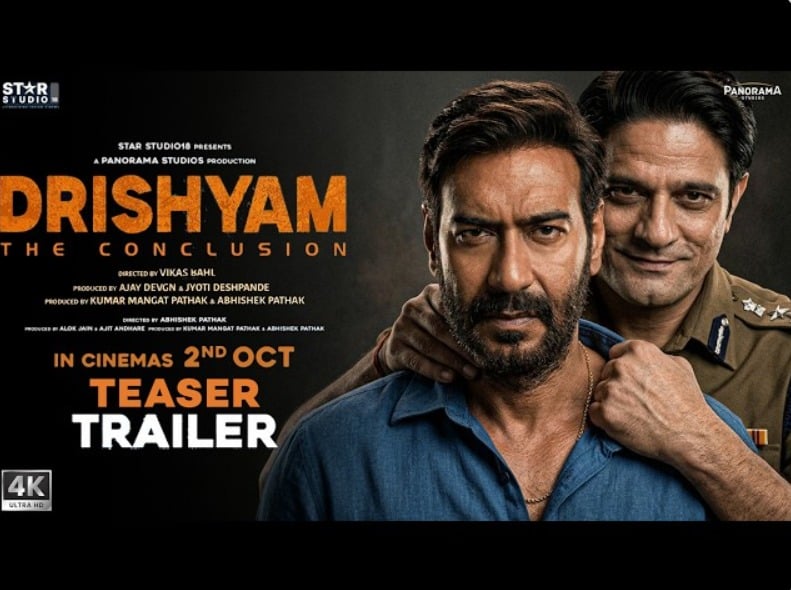
Drishyam 3 The Conclusion Review: On 2 Oct Ajay Devgn’s Final Alibi Closes the Case
Who It Serves and Final Assessment
Udta Teer is best approached as a situational comedy that happens to wear spy clothing rather than as a tightly constructed satire or thriller. Viewers who enjoy Ayushmann Khurrana’s brand of off-centre leading-man work, and who are willing to ride the identity confusion without demanding airtight logic, will find stretches of genuine amusement. Those looking for consistent tonal control, deeper character work for the female lead, or a fully sustained comic critique of espionage tropes may leave with more reservations.
In the broader 2026 Bollywood landscape—crowded with sequels, event films, and genre experiments—Udta Teer occupies a modest but distinct space. It tries something different with a familiar spy template and delivers enough of its promised chaos to justify a look for those already inclined toward the cast. Whether the film finds a second life on streaming will depend on how audiences respond once the theatrical window closes. For now, it stands as an amiable, uneven, and intermittently funny reminder that patriotism, memory, and comedy make for a combustible mix when the arrow is allowed to fly off course.
The film’s ultimate measure may be whether viewers walk out still chuckling at the central joke or wondering why the second half felt obliged to straighten the arrow. Both reactions are already visible in early responses, and both are consistent with what the material actually delivers.
follow me on SPOTIFY As Discovering With Dev